# /iblai-vibe-agent-virtual-machine
> Mirrored from [`iblai/vibe`](https://github.com/iblai/vibe) · [`skills/agents/iblai-vibe-agent-virtual-machine/SKILL.md`](https://github.com/iblai/vibe/blob/main/skills/agents/iblai-vibe-agent-virtual-machine/SKILL.md). This page is generated — edit it in the repository, not here.
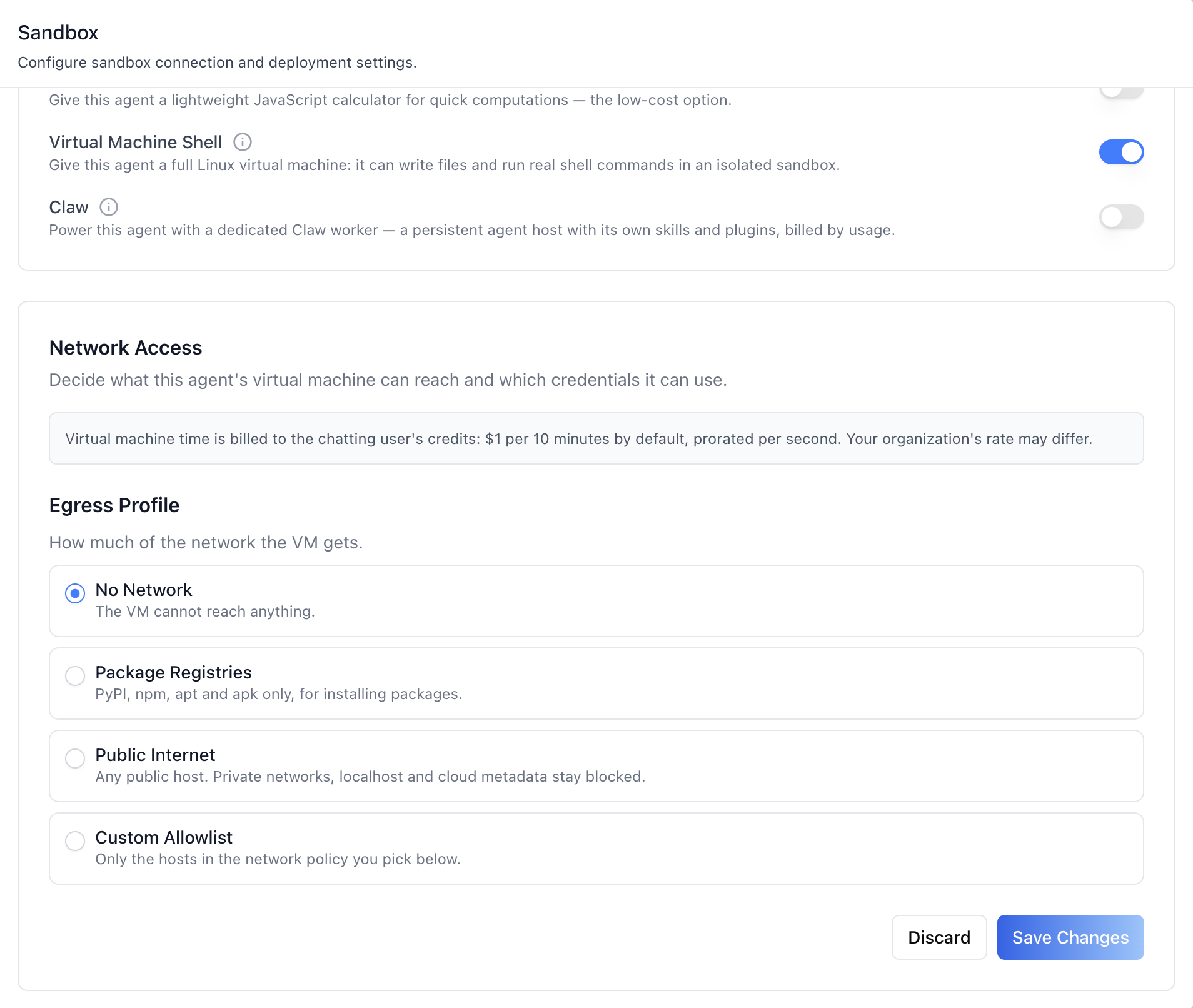
Add the agent Sandbox **Network Access** section -- "Decide what this
agent's virtual machine can reach and which credentials it can use."
It renders under the Sandbox Type card while **Virtual Machine Shell**
is the selected kind, and it holds three controls plus a billing
notice:
- **Egress Profile** — No Network (the default), Package Registries,
Public Internet, Custom Allowlist.
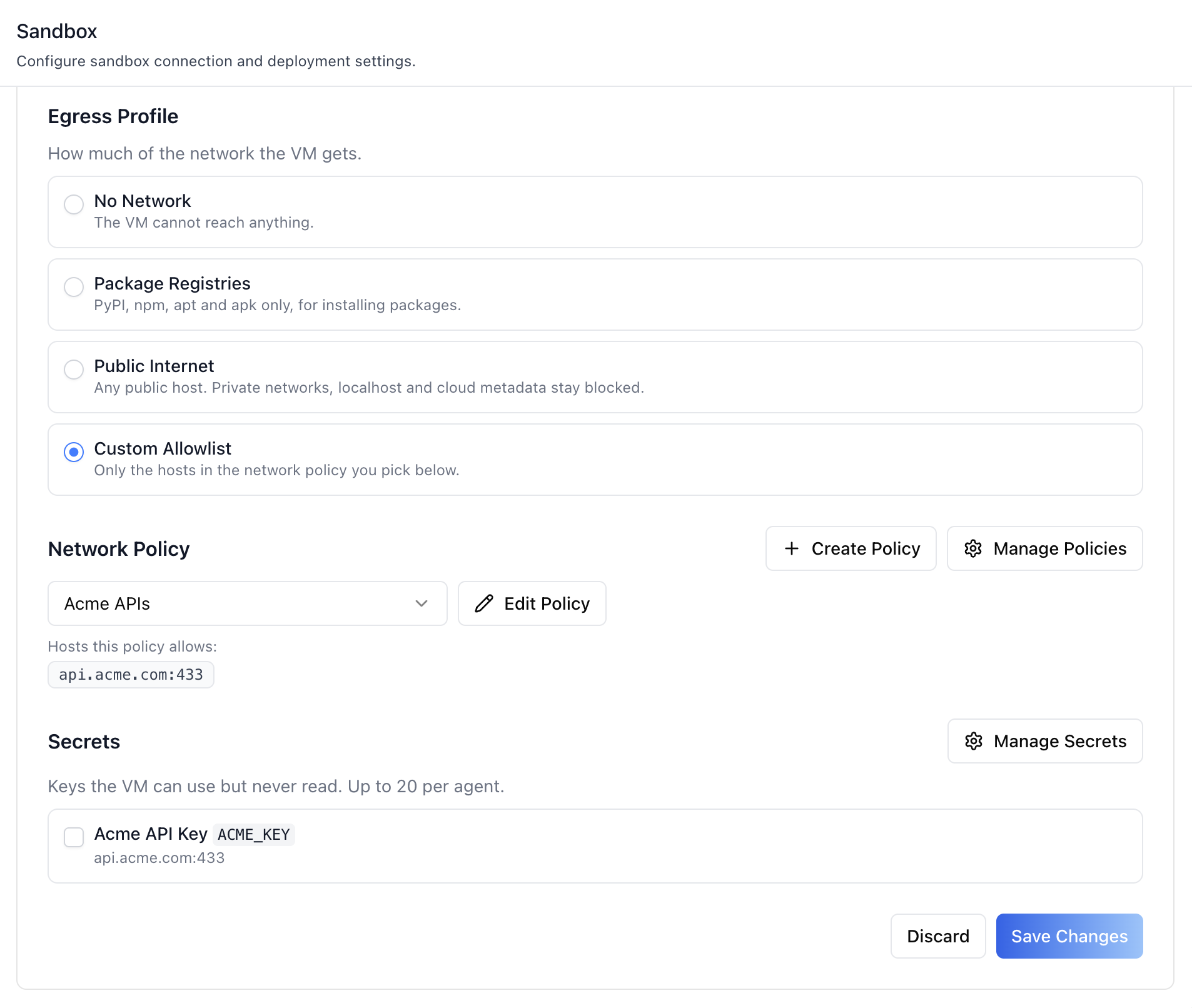
- **Network Policy** — required under Custom Allowlist; a picker over
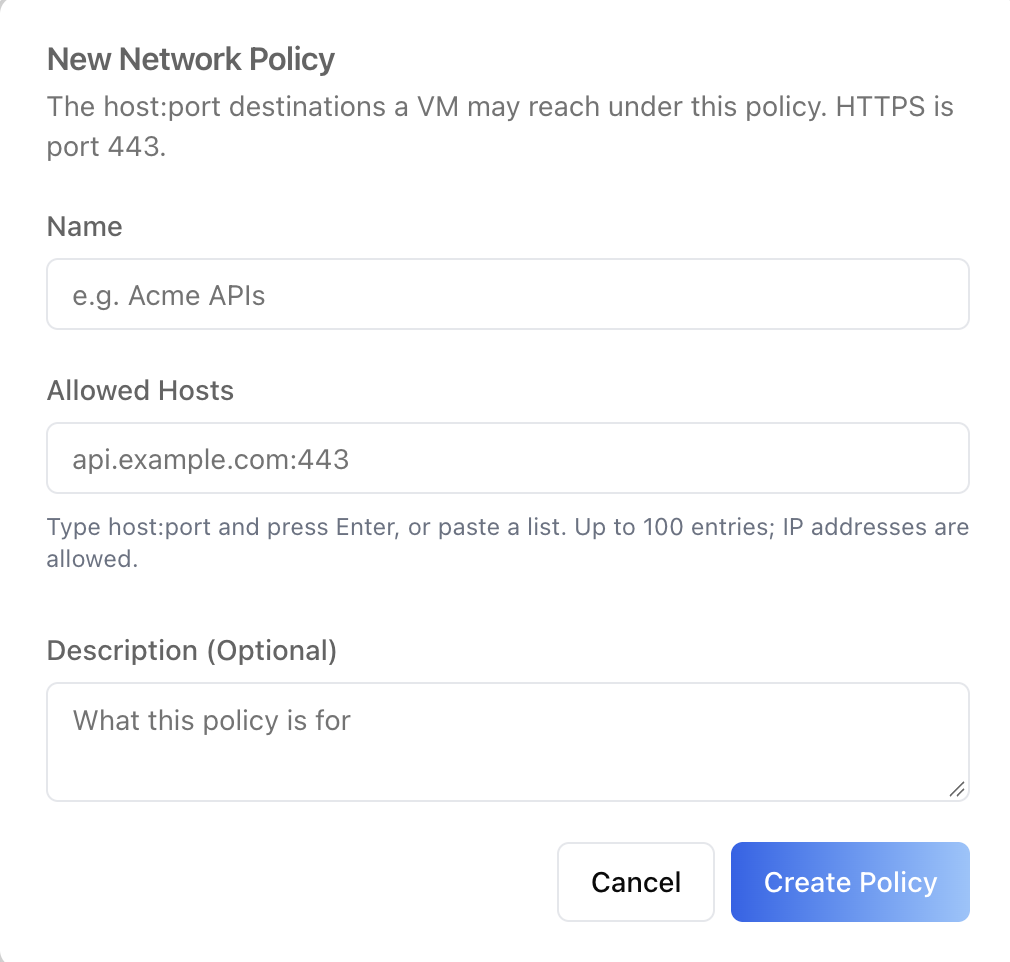
the organization's policies with **Create Policy**, **Edit Policy**
and **Manage Policies** shortcuts and the chosen policy's hosts
listed below it.
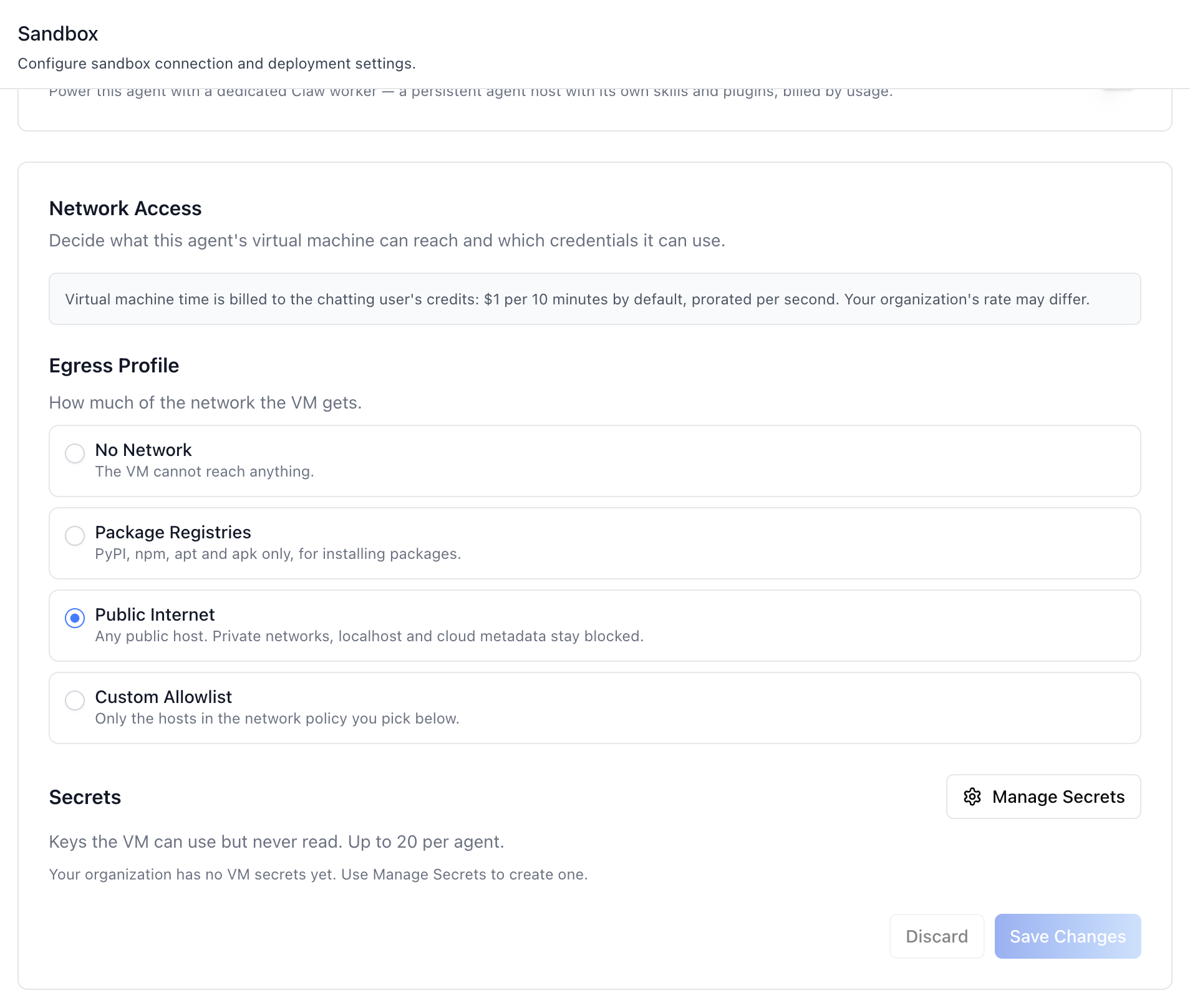
- **Secrets** — shown under Public Internet or Custom Allowlist: a
checkbox list of the organization's VM secrets (keys the VM can use
but never read), capped at 20 per agent, with **Manage Secrets**.
The policies and secrets themselves are organization-wide records
managed in organization settings — see `/iblai-vibe-virtual-machine`.
This section only binds them to one agent.
> **Common setup (brand, conventions, env files, verification):** see [docs/skill-setup.md](https://raw.githubusercontent.com/iblai/vibe/refs/heads/main/docs/skill-setup.md).
## Related surfaces
- **`/iblai-vibe-agent-sandbox`** — the Sandbox tab itself: the
**Sandbox Type** card (Computing Runtime / Virtual Machine Shell /
Claw) and, for Claw, instance management and the prompt files.
`SandboxConfig` mounts this section for you.
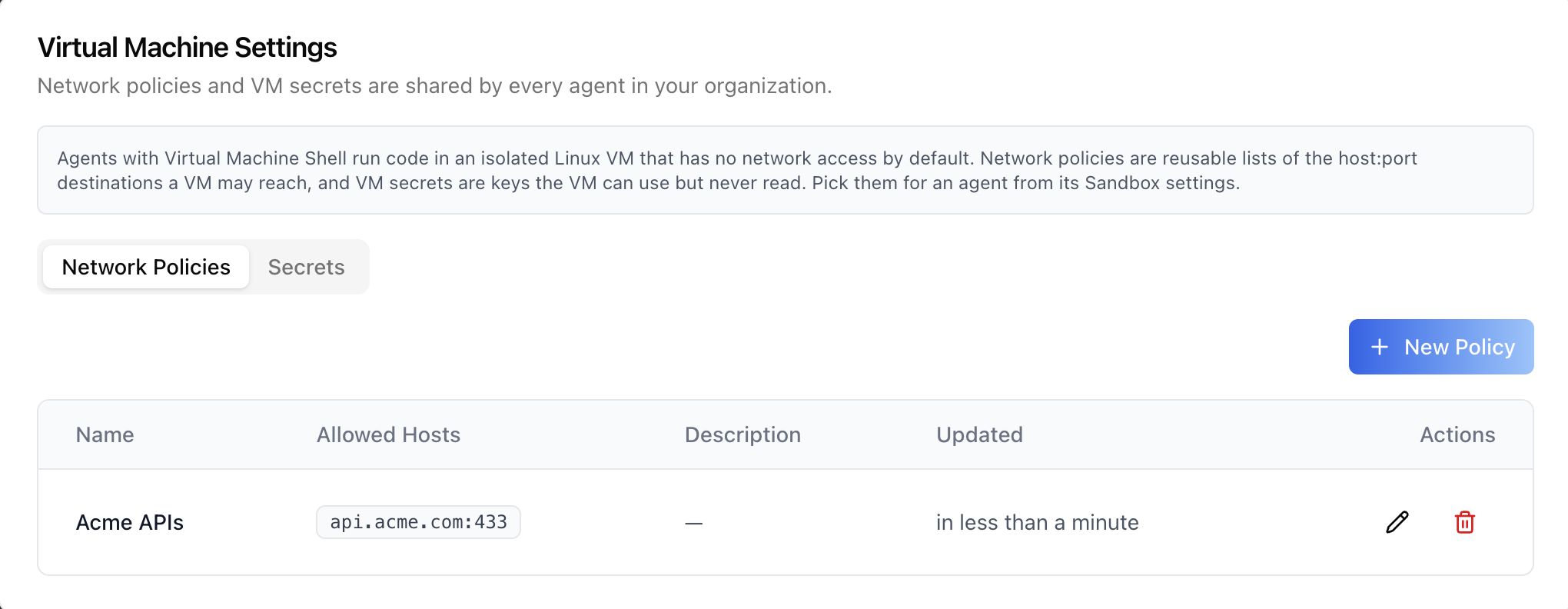
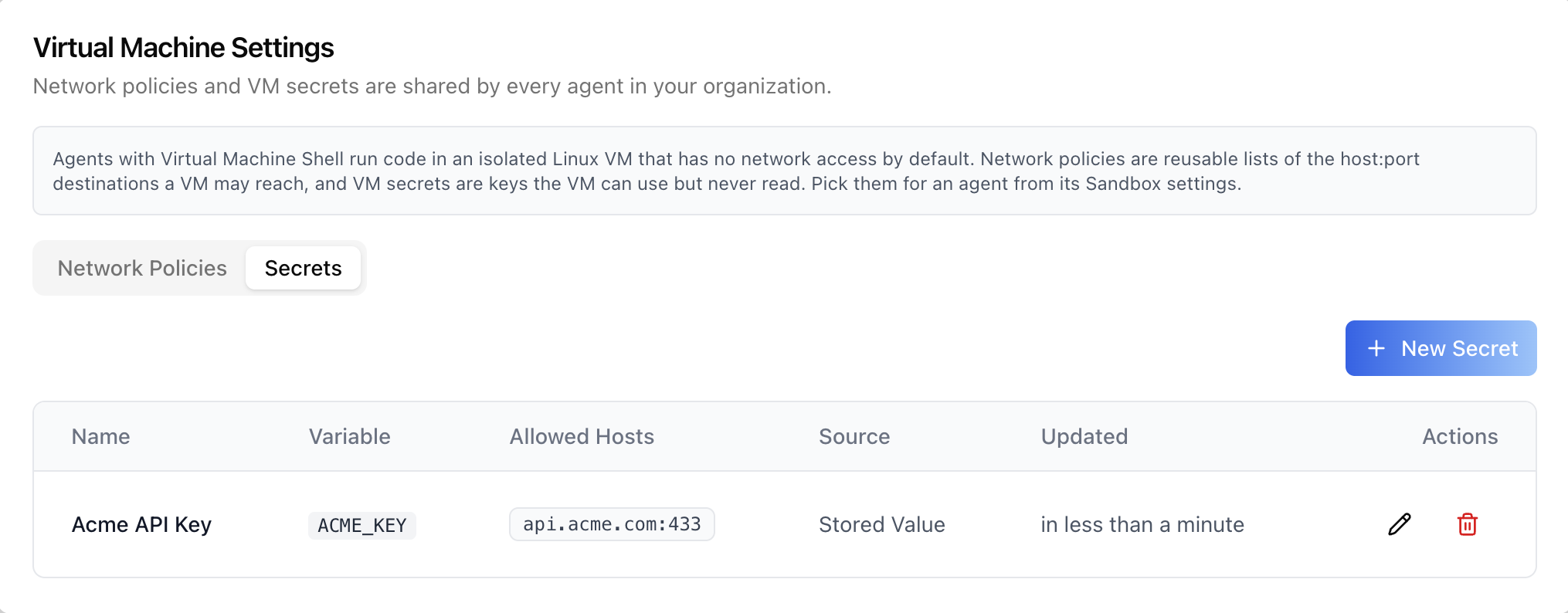
- **`/iblai-vibe-virtual-machine`** — organization settings →
**Virtual Machine**: the Network Policies and Secrets tables behind
the pickers here. The **Manage Policies** / **Manage Secrets**
buttons open that exact surface in a popup.
- **`/iblai-vibe-credential`** — the organization's integration
credentials, which a VM secret can read its value from instead of
storing its own.
## Prerequisites
- Auth must be set up first (`/iblai-vibe-auth`)
- MCP server + skills configured (`@iblai/mcp` in `.mcp.json`)
- Ask the user for a real `mentorId` (agent UUID). Do NOT invent one.
- The agent must have **Virtual Machine Shell** selected
(`enable_virtual_machine: true`) — see `/iblai-vibe-agent-sandbox`.
Nothing here applies to the Computing Runtime or Claw kinds.
- The viewer needs the `Ibl.Mentor/VirtualMachineNetworkPolicies/list`
and `Ibl.Mentor/VirtualMachineSecrets/list` permissions to see the
two pickers; each one hides independently on a 403.
## Step 1: Check Environment
Before proceeding, check for an `iblai.env` in the project root. Look for
`PLATFORM`, `DOMAIN`, and `TOKEN` variables. If the file does not exist or
is missing these variables, tell the user:
"You need an `iblai.env` with your platform configuration. Download the
template and fill in your values:
`curl -o iblai.env https://raw.githubusercontent.com/iblai/vibe/refs/heads/main/iblai.env`"
## Step 2: Mount it
**You usually mount nothing.** `SandboxConfig` renders
`VirtualMachineNetworkSection` itself whenever the agent's
`enable_virtual_machine` flag is on, so following
`/iblai-vibe-agent-sandbox` Step 2 already gives you this section.
Mount it standalone only when you build your own sandbox page:
```tsx
// app/(app)/agents/[mentorId]/network/page.tsx
"use client";
import { useParams } from "next/navigation";
import { VirtualMachineNetworkSection } from "@iblai/iblai-js/web-containers";
export default function AgentNetworkPage({
platformKey,
username,
}: {
platformKey: string;
username: string;
}) {
const { mentorId } = useParams<{ mentorId: string }>();
return (
);
}
```
The component owns its own data: it reads the agent settings, the
organization's policies and the organization's secrets, keeps a local
draft, and saves through **Save Changes** / **Discard**. It does not
read `AgentSettingsProvider`, and it does **not** check
`enable_virtual_machine` — gate the mount yourself if you render it
outside `SandboxConfig`.
## Step 3: Use MCP Tools for Customization
```
get_component_info("VirtualMachineNetworkSection")
get_component_info("SandboxConfig")
get_hook_info("useListVirtualMachineNetworkPoliciesQuery")
```
## Component Props
### `` — `@iblai/iblai-js/web-containers`
| Prop | Type | Required | Description |
|------|------|----------|-------------|
| `platformKey` | `string` | Yes | Organization key (org slug) |
| `mentorUniqueId` | `string` | Yes | Agent UUID |
| `username` | `string` | Yes | Signed-in admin — the mentor-settings path segment, and the agent-name lookup when a policy delete is refused |
## What the section renders
### Billing notice
A grey note above the controls: *"Virtual machine time is billed to
the chatting user's credits: $1 per 10 minutes by default, prorated
per second. Your organization's rate may differ."* The figures come
from `VIRTUAL_MACHINE_DEFAULT_BILLING` (`{ usd: 1, minutes: 10 }`);
the real rate is configurable per organization.
### Egress Profile
Four radio cards, each with a label and one line of explanation:
| Profile | Wire value | Reachability |
|---|---|---|
| No Network | `none` (default) | The VM cannot reach anything |
| Package Registries | `registries` | PyPI, npm, apt and apk only, for installing packages |
| Public Internet | `public` | Any public host; private networks, localhost and cloud metadata stay blocked |
| Custom Allowlist | `custom` | Only the hosts in the network policy picked below |
### Network Policy (Custom Allowlist only)
- A **select** over the organization's policies, plus **Create
Policy** (opens `NetworkPolicyDialog` in place and selects the new
policy on save), **Edit Policy** (same dialog for the current
selection) and **Manage Policies**.
- Below the select, **"Hosts this policy allows:"** with the policy's
`host:port` entries as chips.
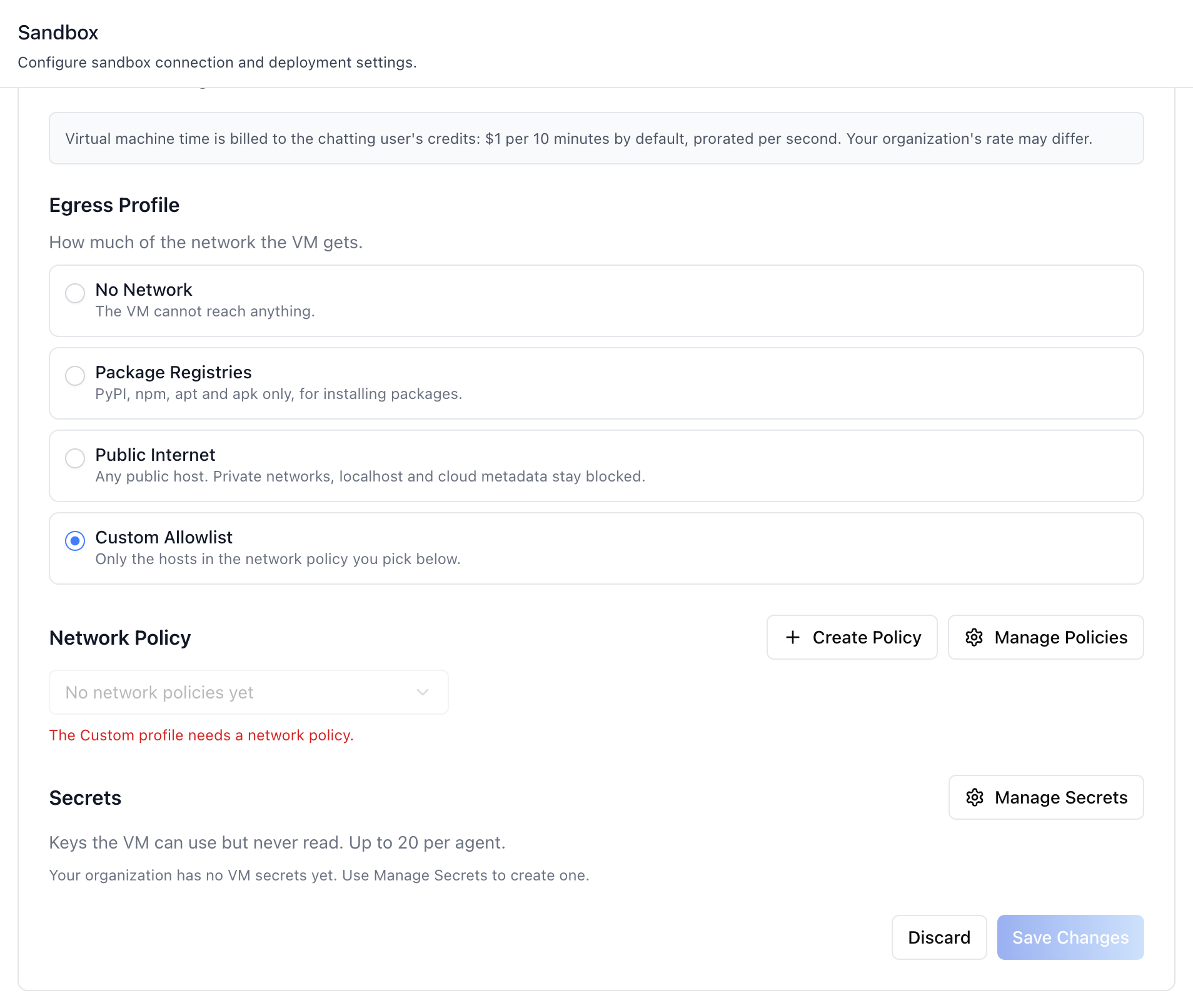
- With nothing picked, *"The Custom profile needs a network policy."*
shows in red and **Save Changes** stays disabled.
- Empty organization → the select reads *"No network policies yet"*
and is disabled; use **Create Policy**.
- No list permission → the whole picker is replaced by a line saying
the profile cannot be configured from here.
### Secrets (Public Internet or Custom Allowlist only)
- *"Keys the VM can use but never read. Up to 20 per agent."*
- One checkbox per organization secret showing its name, its
environment variable as a code chip, and the hosts it may be sent
to. At 20 checked, the unchecked boxes disable and a note says the
cap is reached.
- **Manage Secrets** opens the organization surface on its Secrets
sub-tab.
- No secrets in the organization → *"Your organization has no VM
secrets yet. Use Manage Secrets to create one."*
- No list permission → the whole Secrets block is hidden.
### Manage Policies / Manage Secrets popup
Both buttons open a wide dialog titled **Virtual Machine Settings**
("Network policies and VM secrets are shared by every agent in your
organization.") hosting the same `VirtualMachineAdminTab` the
organization settings page uses, opened on the matching sub-tab — so
an admin never leaves the agent to create what they need here.
## Rules the section enforces before saving
These mirror the backend; getting them wrong is a 400.
| Situation | What happens |
|---|---|
| Custom Allowlist with no policy | Save disabled, inline red message |
| Narrowing to No Network / Package Registries while secrets are bound | An **Unbind Secrets?** dialog; confirming sends `virtual_machine_secret_ids: []` in the same request |
| A bound secret needs a host the chosen policy does not allow | An amber panel lists each `env_var` → missing hosts, with **Add Hosts to {policy} and Save** — one PATCH on the policy, then the settings save |
| More than 20 secrets | Not reachable; the checkboxes disable at the cap |
| Backend 400 | Field errors land under the matching control (`virtual_machine_egress`, `virtual_machine_network_policy_id`, `virtual_machine_secret_ids`); anything else becomes a form-level message |
| Backend 403 on save | "You do not have permission to change these settings." |
Only the keys that actually changed are sent, and the save goes
through `useEditMentorJsonMutation` — **not** the multipart
`useEditMentorMutation`, which drops an empty list and a `null`, so
"unbind every secret" and "clear the policy" would never reach the
backend. Mirror that choice in custom UI.
## Agent settings fields
Read from `GET`, written with `PUT` on
`${dmUrl}/api/ai-mentor/orgs/{org}/users/{username}/mentors/{mentor_unique_id}/settings/`
(a partial update — send only what changes).
| Field | Read shape | Write shape |
|---|---|---|
| `virtual_machine_egress` | `"none" \| "registries" \| "public" \| "custom"` | same |
| `virtual_machine_network_policy` | `{ id, name, allowed_hosts }` or `null` | written as `virtual_machine_network_policy_id: number \| null` |
| `virtual_machine_secrets` | `[{ id, name, env_var, allow_hosts, source_credential_id }]` | written as `virtual_machine_secret_ids: number[]` — replaces the whole set, `[]` unbinds all |
The policy and secret CRUD endpoints themselves are documented in
`/iblai-vibe-virtual-machine`.
## Related Exports
From `@iblai/iblai-js/web-containers`:
- `VirtualMachineNetworkSection`, `VirtualMachineNetworkSectionProps` —
this section.
- `SandboxConfig` — the Sandbox tab that mounts it (see
`/iblai-vibe-agent-sandbox`).
- `VirtualMachineAdminTab` — what **Manage Policies** / **Manage
Secrets** render inside the popup (`defaultTab` picks the sub-tab).
- `HostPortChipInput`, `HostPortChipInputProps` — the `host:port` chip
input the policy dialog uses; reusable for any allowlist field.
From `@iblai/iblai-js/data-layer`:
- `useGetMentorSettingsQuery`, `useEditMentorJsonMutation` — read and
write the three agent fields above.
- `useListVirtualMachineNetworkPoliciesQuery`,
`useUpdateVirtualMachineNetworkPolicyMutation` — the picker's
options and the "add the missing hosts" PATCH.
- `useListVirtualMachineSecretsQuery` — the secrets checkboxes.
- `VIRTUAL_MACHINE_EGRESS_PROFILES`,
`VIRTUAL_MACHINE_MAX_SECRETS_PER_MENTOR` (20),
`VIRTUAL_MACHINE_DEFAULT_BILLING` (`{ usd: 1, minutes: 10 }`) — the
constants the UI is built from.
- `isVirtualMachineEgressNetworked` — true for `public` and `custom`
(the profiles that may carry secrets).
- `findUncoveredSecretHosts` — the bound-secret-vs-policy check behind
the amber panel.
- `getVirtualMachineApiError`, `getVirtualMachineErrorStatus` —
normalise a 400 into `{ message, fieldErrors }` and read the status
off an RTK Query error.
- Types: `VirtualMachineEgress`, `MentorVirtualMachineSettings`,
`MentorVirtualMachineSettingsUpdate`, `VirtualMachineNetworkPolicy`,
`VirtualMachineSecret`, `VirtualMachineUncoveredSecretHosts`.
SDK source: `packages/web-containers/src/components/claw-sandbox/virtual-machine-network-section.tsx`,
with the shared dialog at `components/virtual-machine/network-policy-dialog.tsx`
and the data layer under `packages/data-layer/src/features/virtual-machine/`.
## Step 4: Verify
Run `/iblai-vibe-ops-test` before telling the user the work is ready:
1. `pnpm build` -- must pass with zero errors
2. `pnpm test` -- vitest must pass
3. Touch test `/agents//sandbox` in the browser as `/iblai-vibe-ops-test` says: open it,
use every control this skill added, read the console, check the phone width.
## Important Notes
- **Redux store**: Must include `mentorReducer` and `mentorMiddleware`
(they register `virtualMachineApiSlice`)
- **`initializeDataLayer()`**: 5 args (v1.2+)
- **`@reduxjs/toolkit`**: Deduplicated via webpack aliases in `next.config.ts`
- **Peer deps**: `sonner` and `@iblai/iblai-web-mentor` must be installed
(`pnpm add sonner @iblai/iblai-web-mentor`)
- **No network is the default.** A new agent on Virtual Machine Shell
reaches nothing until someone picks a profile here. Treat that as
the feature, not a gap.
- **Secrets are for the VM, not the agent.** Inside the machine the
environment variable holds a placeholder; the real value is
substituted only on TLS requests to the secret's `allow_hosts`. The
agent never sees it, and no endpoint ever returns it.
- **Secrets need a networked profile.** They only appear under Public
Internet and Custom Allowlist, and narrowing the profile unbinds
them — with a confirmation first.
- **Two independent 403s.** The policy picker and the Secrets block
gate on their own list permission. One can be visible while the
other is not; the save itself can still 403 separately.
- **Policies are shared.** Editing a policy from here changes it for
every agent bound to it, and the edit dialog warns when you remove a
host a bound secret still needs.
- **`mentorUniqueId` vs `mentorId`**: these endpoints key on the
agent's UUID, not the integer pk — the same UUID as the rest of the
agent-* family.
- **Brand guidelines**: [BRAND.md](https://raw.githubusercontent.com/iblai/vibe/refs/heads/main/BRAND.md)