---
title: "Agentic Vibe 2.0: Build an AI App From Your Coding Agent"
slug: "agentic-vibe-2-ai-apps-from-your-coding-agent"
date: "2026-09-28"
tag: "Application"
summary: "Agentic Vibe 2.0 turns Claude Code, OpenAI Codex or Cursor into an ibl.ai app builder: one install of 154 skills, four questions, and a working AI app with sign-in, an agent, users and admins, memory, analytics and billing — shippable to the web, desktop and mobile."
author: "ibl.ai Engineering"
repo: "iblai/vibe"
linkedin: |
  Four questions, one install, and your coding agent builds a working AI app — sign-in, an agent, an admin area, analytics and billing included.

  That is Agentic Vibe 2.0, the toolkit we released on September 9. It installs into the coding agent you already use — Claude Code, OpenAI Codex, Cursor, OpenCode or Copilot — with a single command: npx skills add iblai/vibe --all.

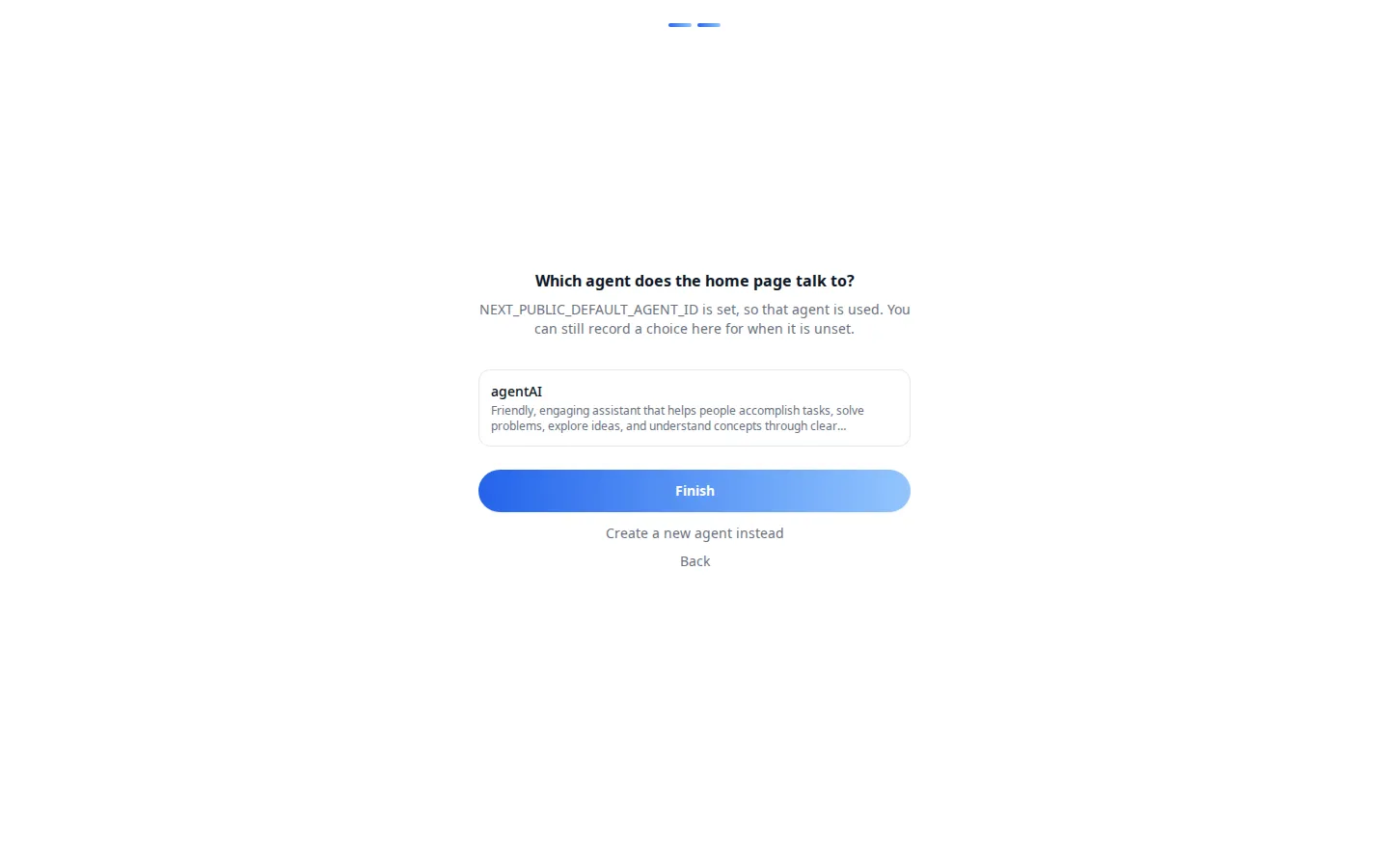
  Then you type /iblai-vibe-start. It asks whether this is a new project or existing code, whether you serve one organization or many, who signs in, and what the app is about.

  It connects your ibl.ai organization with one click in the browser — the API token never passes through the chat — and builds.

  What comes out is not a demo. SSO sign-in pinned to your organization. A home page that is a chat with your agent. A User/Admin switch and an admin area for people, invites, roles, analytics, billing, memory and organization settings. Tests in Vitest and Playwright.

  No database of your own to run.

  154 skills sit behind it — 54 that mount a screen in your app, 66 that do the same work headlessly over REST — and one command ships the result to a URL, or to macOS, Windows, iOS and Android.

  We shipped 40 releases of the toolkit in the 31 days to September 23. That pace is the point: you pull the release when it suits you.

  And the ownership model is the reason it matters. With ibl.ai you own all the code and the data — the toolkit is MIT-licensed, the app it builds is yours, and the whole platform behind it can run on your own infrastructure.

  #iblai #AgenticAI #EnterpriseAI #ClaudeCode #AIApps #DeveloperTools
---

**Agentic Vibe 2.0 turns the coding agent you already use into an ibl.ai app builder: one install, four questions, and a working AI app with sign-in, an agent, users and admins, memory, analytics and billing — and on ibl.ai you own all the code and the data.**

The toolkit is MIT-licensed on GitHub, and the app it builds is yours to ship to the web, desktop and mobile.

Version 2.0 of [iblai/vibe](https://github.com/iblai/vibe) shipped on **September 9, 2026**. It merged two toolkits into one install, rebuilt the documentation around the journey a builder actually takes, and put the core app into a starter template.

It is one of **40 releases in the 31 days to September 23** — **26 of them in the fourteen days after 2.0 shipped**.

## How do you build an ibl.ai app from Claude Code, Codex or Cursor?

You install the skills into the agent you already use, then start a conversation. One command covers Claude Code, OpenAI Codex, Cursor, OpenCode and Copilot:

```bash
npx skills add iblai/vibe --all
```

Claude Code users can install it as a plugin instead — the same skills plus the SDK-docs MCP server, updated with `/plugin update` — through `/plugin marketplace add iblai/vibe` and `/plugin install iblai-vibe@iblai`.

Then you type `/iblai-vibe-start`. It asks **four questions**: a new project or existing code; one organization, many, or none; who signs in; and what the app is about. Every other skill reads the answers, so the rest of the build fits the shape you chose.

<a href="/images/updates/agentic-vibe-2-ai-apps-from-your-coding-agent-setup.webp" target="_blank" rel="nofollow noopener noreferrer"><img src="/images/updates/agentic-vibe-2-ai-apps-from-your-coding-agent-setup.webp" alt="The Agentic Vibe starter's setup screen asking Which agent does the home page talk to?, with an agent named agentAI selected, a Finish button, and a Create a new agent instead link." width="1440" height="900" loading="lazy" decoding="async" /></a>

Connecting the app to an ibl.ai organization is **one click in the browser**, or two pasted values. The API token is written straight into the project's environment files and **never passes through the chat** — the coding agent builds with it but never sees it.

**Thirty seconds after you sign in, you are chatting with your own agent**, with users, an admin area, custom user and organization settings, memory, analytics and billing already wired.

## What does the Agentic Vibe starter app include?

The starter is a real application, not a demo page. After sign-in, the home page is a conversation with your agent, with suggested follow-ups, voice input, Canvas and Memory in the composer.
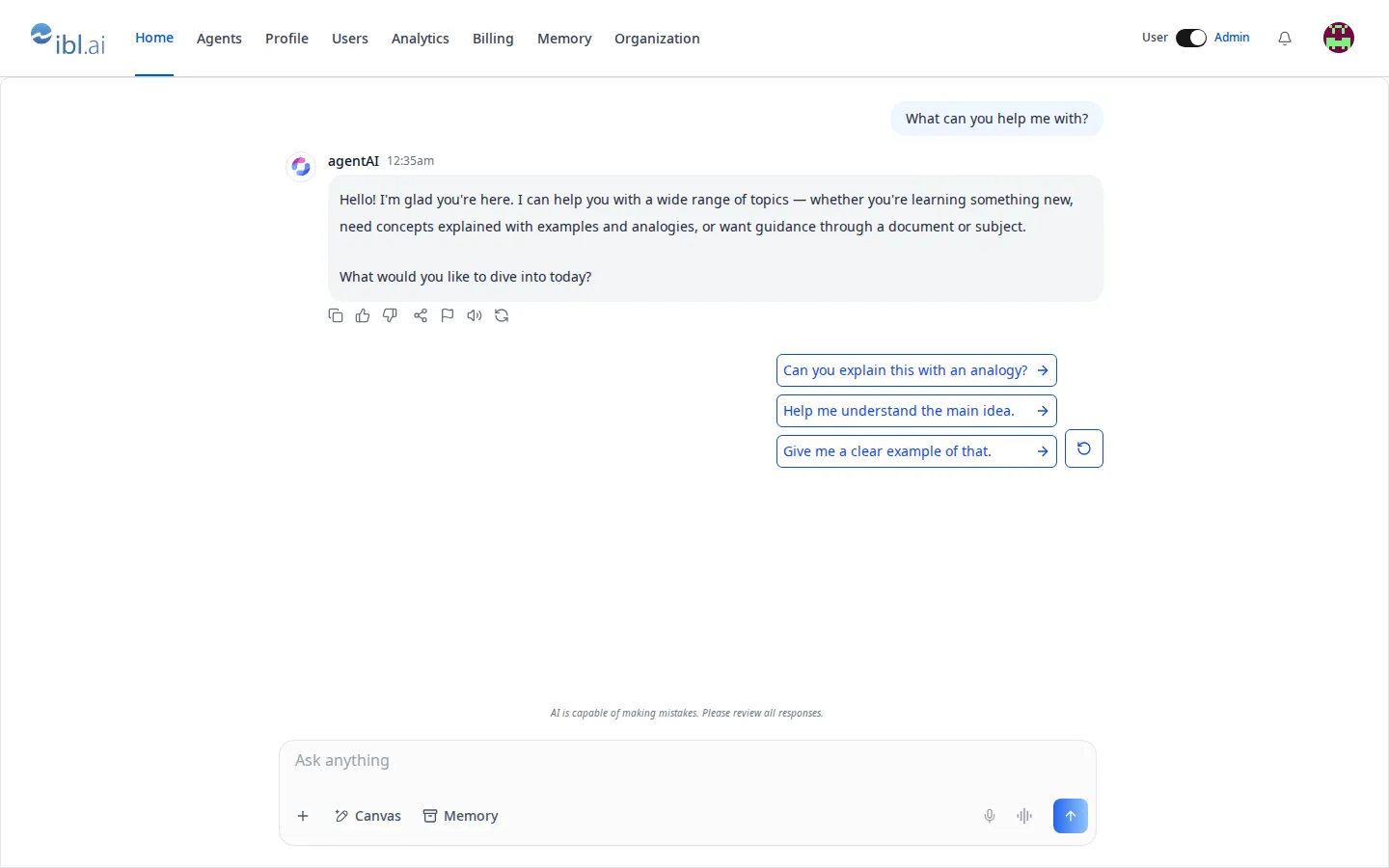
<a href="/images/updates/agentic-vibe-2-ai-apps-from-your-coding-agent-home-chat.webp" target="_blank" rel="nofollow noopener noreferrer"><img src="/images/updates/agentic-vibe-2-ai-apps-from-your-coding-agent-home-chat.webp" alt="The Agentic Vibe starter app's home page as an admin: a navigation bar with Home, Agents, Profile, Users, Analytics, Billing, Memory and Organization, a User/Admin switch, and a chat with an agent answering What can you help me with?, three suggested follow-up questions, and a composer with Canvas and Memory." width="1440" height="900" loading="lazy" decoding="async" /></a>

Out of the box, the starter wires up:

- **Sign-in** with ibl.ai SSO, pinned to your organization.
- **A home page that is a chat** with your agent, `/agents` to browse, and `/setup` to pick or create one.
- **Users and admins** — a profile, a User/Admin switch, and an admin area for people, invites, roles, analytics, billing, memory and organization settings.
- **Custom data per user and per organization**, stored on the platform — no database of your own to run.
- **Tests** in Vitest and Playwright, plus a server helper for anything the components don't cover.

The same app reads differently to each person. An administrator sees eight sections; a user sees Home, Agents and Profile. The switch in the top right moves between the two views.
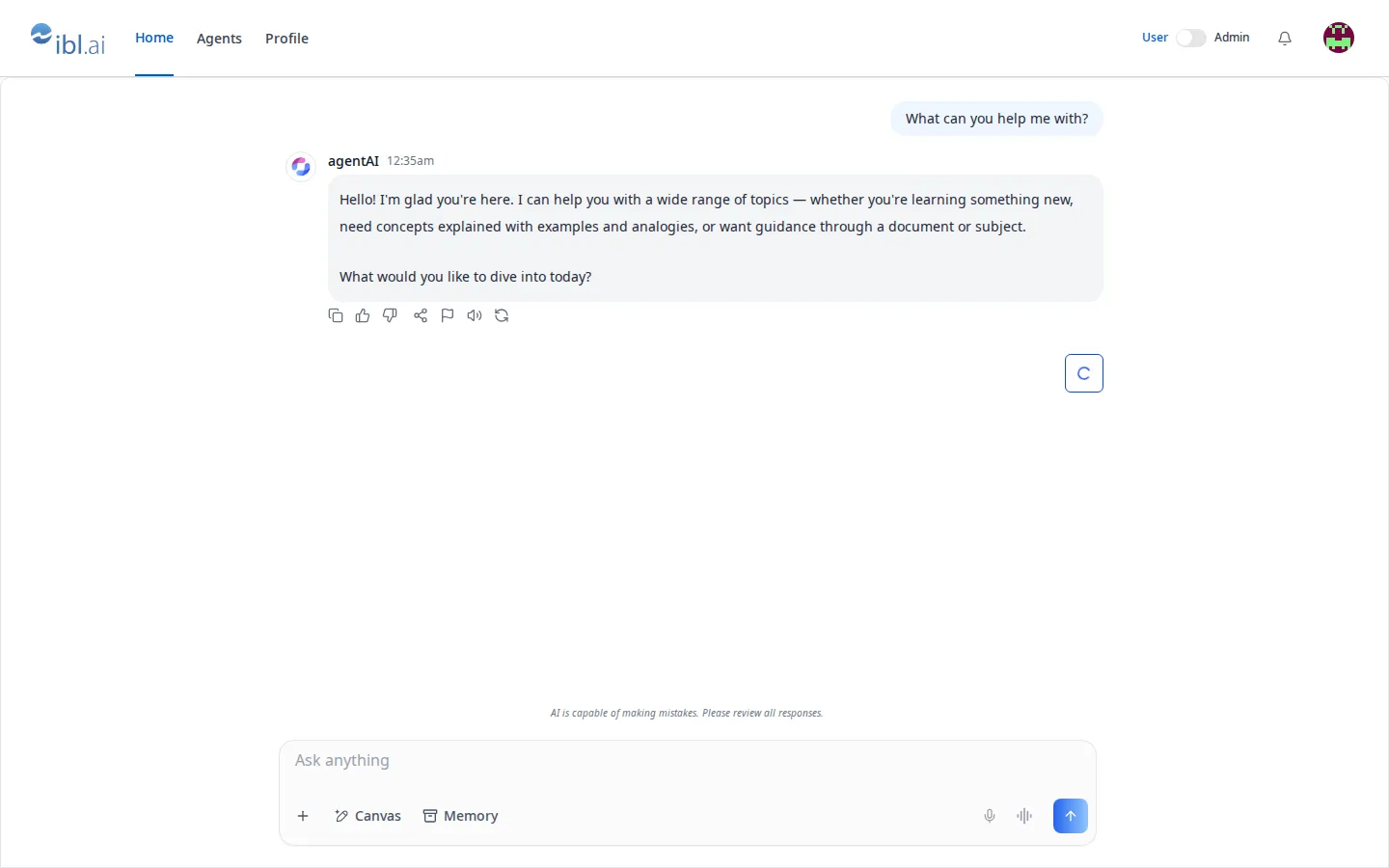
<a href="/images/updates/agentic-vibe-2-ai-apps-from-your-coding-agent-user-mode.webp" target="_blank" rel="nofollow noopener noreferrer"><img src="/images/updates/agentic-vibe-2-ai-apps-from-your-coding-agent-user-mode.webp" alt="The same Agentic Vibe starter app in User mode: the navigation bar shows only Home, Agents and Profile, beside the chat with the agent." width="1440" height="900" loading="lazy" decoding="async" /></a>

## How do admins manage users in an app built with Agentic Vibe?

Through the platform's own management screens, mounted in your app. The Management panel has seven tabs — Users, Groups, Roles, Policies, Teams, Alerts and Applications — with search, invitations, a role per person and a policy set per person.
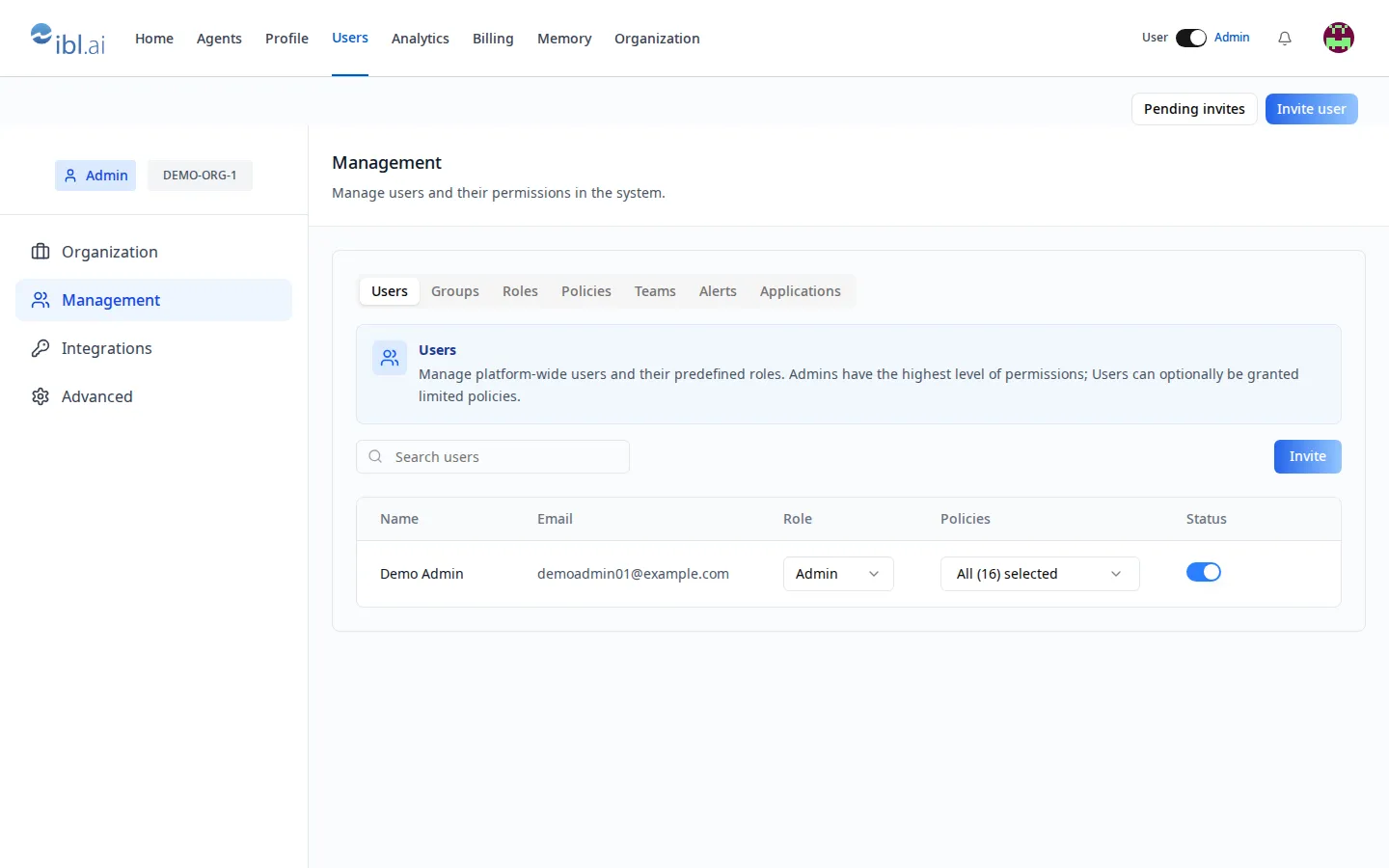
<a href="/images/updates/agentic-vibe-2-ai-apps-from-your-coding-agent-admin-users.webp" target="_blank" rel="nofollow noopener noreferrer"><img src="/images/updates/agentic-vibe-2-ai-apps-from-your-coding-agent-admin-users.webp" alt="The Management panel inside the Agentic Vibe starter app, with tabs for Users, Groups, Roles, Policies, Teams, Alerts and Applications, a Search users field, an Invite button, and a demo admin listed with the Admin role, all 16 policies selected, and an active status toggle." width="1440" height="900" loading="lazy" decoding="async" /></a>

None of this is a mock-up to be rebuilt later. Roles and policies are the platform's role-based access control, so what you grant in your app is enforced by the same backend that runs [Agentic OS](/product/agentic-os).

## What are the two skill families in Agentic Vibe 2.0?

Version 2.0 merged the separate `iblai/api` toolkit into `iblai/vibe`, so **one install now carries two families**. Skills named `iblai-vibe-*` mount a visual component in your app; skills named `iblai-api-*` do the same work headlessly over REST, for a script, a CI job or your own backend.

<table style="width:100%; border-collapse:collapse; margin:1.5rem 0; font-size:0.95rem;">
  <thead>
    <tr style="background:#f5f5f0; border-bottom:2px solid #2175C5;">
      <th style="text-align:left; padding:0.75rem; color:#5f6368;">Kind</th>
      <th style="text-align:left; padding:0.75rem; color:#5f6368;">What it produces</th>
      <th style="text-align:right; padding:0.75rem; color:#5f6368;">Skills</th>
    </tr>
  </thead>
  <tbody>
    <tr style="border-bottom:1px solid #e5e7eb;"><td style="padding:0.75rem;"><strong>ui</strong></td><td style="padding:0.75rem;">A screen in your app — a page, tab, dialog or widget</td><td style="text-align:right; padding:0.75rem; font-variant-numeric:tabular-nums;">54</td></tr>
    <tr style="border-bottom:1px solid #e5e7eb;"><td style="padding:0.75rem;"><strong>api</strong></td><td style="padding:0.75rem;">The exact REST contract, a script or a server route</td><td style="text-align:right; padding:0.75rem; font-variant-numeric:tabular-nums;">66</td></tr>
    <tr style="border-bottom:1px solid #e5e7eb;"><td style="padding:0.75rem;"><strong>guide</strong></td><td style="padding:0.75rem;">A decision page that routes you to the right skill</td><td style="text-align:right; padding:0.75rem; font-variant-numeric:tabular-nums;">15</td></tr>
    <tr style="border-bottom:1px solid #e5e7eb;"><td style="padding:0.75rem;"><strong>ops</strong></td><td style="padding:0.75rem;">Builds, tests, deploys, releases and upgrades</td><td style="text-align:right; padding:0.75rem; font-variant-numeric:tabular-nums;">11</td></tr>
    <tr style="border-bottom:1px solid #e5e7eb;"><td style="padding:0.75rem;"><strong>security</strong></td><td style="padding:0.75rem;">Authorized-use security reviews</td><td style="text-align:right; padding:0.75rem; font-variant-numeric:tabular-nums;">8</td></tr>
    <tr style="background:#f0f9ff;"><td style="padding:0.75rem;"><strong>Total</strong></td><td style="padding:0.75rem;">One install</td><td style="text-align:right; padding:0.75rem; font-variant-numeric:tabular-nums;"><strong>154</strong></td></tr>
  </tbody>
</table>

Most capabilities exist in both families. Custom data per user, for example, is `/iblai-vibe-user-metadata` with a screen or `/iblai-api-profile-metadata` without one — pick by where the code runs.

## How do you ship an app built with Agentic Vibe?

With one more skill. `/iblai-vibe-ops-deploy` gives you a URL; `/iblai-vibe-ops-build` wraps the same codebase in Tauri and builds it for **macOS, Windows, iOS and Android**. The [deployment paths](/updates/deploy-ai-app-web-server-app-stores) cover platform hosting, your own server, and the app stores.

The toolkit runs against ibl.ai's hosted environment by default. The full platform codebase — the backend these skills talk to — is available under license to run on your own infrastructure, which is where the ownership model stops being a feature and becomes the architecture.

More on the product at [Agentic Vibe](/product/agentic-vibe), and the mirrored documentation at [/developer/vibe](/developer/vibe).

## Want to build your organization's AI app this way?

The ibl.ai team builds with these same skills every day, and we can stand one up with you on your data. [Book a 30-minute demo](https://cal.com/iblai/30min) or [talk to the ibl.ai team](/contact) — ibl.ai is family-owned and operated from New York, NY.
