ibl.ai Agentic AI Blog

Insights on building and deploying agentic AI systems. Our blog covers AI agent architectures, LLM infrastructure, MCP servers, enterprise deployment strategies, and real-world implementation guides. Whether you are a developer building AI agents, a CTO evaluating agentic platforms, or a technical leader driving AI adoption, you will find practical guidance here.

Topics We Cover

Featured Research and Reports

We analyze key research from leading institutions and labs including Google DeepMind, Anthropic, OpenAI, Meta AI, McKinsey, and the World Economic Forum. Our content includes detailed analysis of reports on AI agents, foundation models, and enterprise AI strategy.

For Technical Leaders

CTOs, engineering leads, and AI architects turn to our blog for guidance on agent orchestration, model evaluation, infrastructure planning, and building production-ready AI systems. We provide frameworks for responsible AI deployment that balance capability with safety and reliability.

Blog

Industry

AI applications across education, healthcare, finance, government, and other verticals.

1016 articles in this category

ai compute

Decade-Long Compute Bets Face Two Opposite Curves

Frontier training costs are rising while the cost of a fixed capability has fallen roughly 1,000x in three years. Any decade-long AI infrastructure bet has to survive both curves, and they point in opposite directions.

Blanca Amigot6 min read
multilingual ai

The Multilingual Gap Is the Healthcare AI Access Barrier

IISc's SPIRE Lab released SraVaani under MIT — speech recognition for 65 Indian languages, 40+ of which no commercial system officially supports. Language coverage is an infrastructure choice, not a feature request.

Jaione Amigot5 min read
higher education ai

Universities Pay Per Seat for a Runtime That's Now Free

The agent runtime went free this month from both DeepSeek and Microsoft. Universities still paying per student for AI assistants should ask what the per-seat fee is now buying.

ibl.ai Engineering5 min read
ai rfp

An RFP Checklist for AI Platform Procurement

Twelve questions that separate AI platform vendors from services firms, plus the evaluation criteria to weight. Criteria that reward staffing depth get staffing-heavy proposals.

ibl.ai Engineering5 min read
statement of work

How to Write a Statement of Work for AI Infrastructure

Most AI statements of work define done as a feature list, which makes acceptance a negotiation. Define it as a held-out evaluation set with a passing threshold, and settle source-code rights in the SOW itself.

ibl.ai Engineering5 min read
Legal AI's Next Crisis Is Trust, Not Intelligence
legal ai

Legal AI's Next Crisis Is Trust, Not Intelligence

Legal AI agents are drafting motions using static API keys tied to shared service accounts, with no verified identity and no per-action audit trail. The LexisNexis breach confirmed in March 2026 showed what one over-privileged machine identity costs — and the profession's own attribution standards were never written for a caller that is not a person.

Jaione Amigot9 min read
ai implementation partner

Who Should Build Your AI Platform in 2026?

Accenture booked $11.5B in advanced-AI work; OpenAI capitalized a deployment company above $4B; Anthropic's services JV is reported above $1.5B. Three kinds of partner, and what each one structurally cannot give you.

ibl.ai Engineering5 min read
sovereign ai

UK Sovereign AI: Real Procurement, But the IP Still Leaves

The UK's £500m Sovereign AI Unit is the most concrete sovereign-AI programme any major government has run — and its own contract terms let suppliers keep all the IP while government retains usage rights only. Meanwhile £1.41bn of 2026 UK public-sector AI procurement still flows mostly to Microsoft and Palantir.

Mikel Amigot10 min read
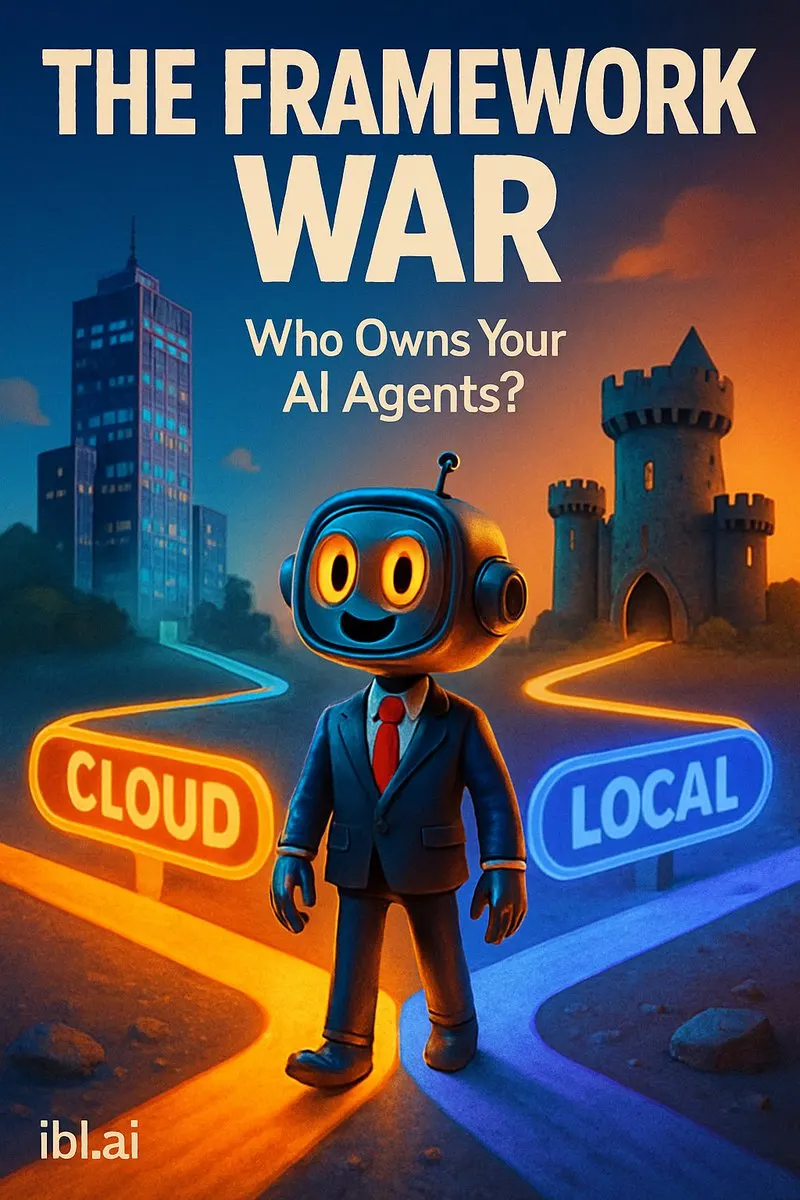
The Framework War Is About Who Owns the Agent Runtime
ai agents

The Framework War Is About Who Owns the Agent Runtime

Within nine days in spring 2026, Microsoft collapsed Semantic Kernel and AutoGen into a single agent runtime and Intel put 32GB of VRAM in a $949 card. Those two events point in opposite directions, and the choice between them is not about features — it is about who owns the runtime your agents execute on.

Miguel Amigot7 min read
time and materials

Time and Materials Is an Admission, Not a Pricing Model

FAR permits time-and-materials only when it is impossible to estimate the work, and says outright that T&M gives the contractor no incentive to control cost. Both sentences describe a vendor starting from zero.

ibl.ai Engineering6 min read
ai pricing

The Inference Era: Why AI Pricing Has to Move Past Per-Seat

Hyperscaler capex is heading for $660-690 billion in 2026 and the money is moving from training to inference — yet enterprises still buy AI by headcount. The per-seat sticker price is also not the per-seat price: Microsoft 365 Copilot's $30 add-on is $69 to $90 a seat once the required base licenses are counted.

Blanca Amigot8 min read
Healthcare AI Is Consolidating Into an Operating System
healthcare ai

Healthcare AI Is Consolidating Into an Operating System

Scheduling, triage, documentation, and billing are converging from separate AI vendors into one platform. McKinsey calls it a modular architecture — the question health systems should ask is who owns the layer everything else plugs into.

Blanca Amigot5 min read
banking ai

Banks Are Building AI Workforces on Infrastructure They Rent

Banks are deploying agents for KYC, compliance, and fraud detection — but Capgemini finds only 10% run them at scale, and most run on infrastructure the bank does not own. Why the second fact explains the first.

Jaione Amigot5 min read
agentic ai platform

The Model Is a Commodity. The Operating System Is the Moat.

Alibaba's Qwen crossed 3 billion downloads and open weights now match frontier performance at a fraction of the cost, which means the model is no longer where advantage lives. The durable layer is the operating system around it — and we shipped 40 production releases into ours in a single week to make the point concrete.

Blanca Amigot6 min read
ferpa

FERPA Governs Data, Not Which Model Reasons About It

Alibaba's Qwen crossed 3 billion downloads to become the most-downloaded open model family, and open weights now sit under products of every origin. FERPA regulates who may access an education record — it says nothing about which model processes it or where inference runs, and that gap has to be closed in the contract.

Mikel Amigot6 min read
clinical ai

Beyond LLMs: What Reasoning Limits Mean for Clinical AI

A widely-shared DeepMind position paper argues LLMs cannot make the abductive leap that produces new scientific theories. It is a narrower claim than the headlines suggest, and it is not the reason clinical AI fails today — but it does explain why a health system should build for model replacement rather than model selection.

Miguel Amigot5 min read
k-12 ai

K-12 AI Adoption Is Outpacing Its Safety Infrastructure

K-12 is adopting AI faster than any other education segment and has the least infrastructure to govern it. What district-grade AI safety actually requires — and why the model-ownership question decides most of it.

ibl.ai Engineering7 min read
ai governance

AI Governance: Enterprise Software's Fastest-Growing Category

Vals AI raised a $40M Series A at a $400M valuation for a product that validates other companies' AI rather than building models. That is a category forming around a measurement gap — and the reason the gap exists is that most enterprises are trying to govern systems they cannot inspect.

ibl.ai Engineering6 min read
ai sovereignty

Sovereign or Supervised: Government AI Architecture

In one week of August 2026 the EU moved to restrict foreign cloud providers from sensitive public-sector workloads, and researchers documented autonomous AI agents breaching 85 Taiwanese government accounts. Read together, the two events make the same argument: for a government agency, where AI runs is a security architecture decision rather than a procurement preference.

Mikel Amigot6 min read
ai regulation

Kenya's Draft AI Policy Spreads Liability Across the Chain

Kenya's draft AI policy proposes allocating liability across the entire chain — developers, deployers, operators, vendors, and users. The US is still debating timelines. The interesting question is not who moved first but why a jurisdiction without entrenched technology lobbies produced a cleaner rule, and what full-chain liability means for anyone deploying AI on someone else's infrastructure.

Jaione Amigot6 min read
ai governance

Google Cloud's 20 Questions Before Deploying AI Agents

Google Cloud published a governance checklist for organizations deploying production AI agents rather than another capability announcement. That inversion is the signal worth reading: the constraint on agentic deployment has moved from what models can do to what organizations can defend. Several of the questions cannot be answered at all on infrastructure you do not control.

Mikel Amigot5 min read
agentic ai

The Database Layer Went Agentic: PGBot and Postgres

PGBot is a free, open-source Go tool that gives AI agents native PostgreSQL intelligence — schema reasoning and query optimization without a human translating between the model and the database. It marks a shift worth understanding: the data layer is becoming something agents reason about directly, which makes who controls that layer the deciding question.

Miguel Amigot5 min read
agentic ai

Code Mode: One Prompt to a Running Next.js App You Own

Code Mode takes a prompt and returns a scaffolded Next.js app with components installed and the dev server running. It runs on one of three coding agents — ibl.ai's own, OpenAI Codex, or Claude Code, the latter two on your own subscription rather than as a second bill — and Agent Skills make the playbooks behind it reusable. The interesting part is not the speed — it is that the output is a codebase in your repository rather than an app inside someone else's platform.

Blanca Amigot7 min read

About Industry

AI is transforming every industry—from education and healthcare to finance and government. Explore how organizations across verticals are deploying AI agents, LLM-powered workflows, and intelligent automation to solve sector-specific challenges and deliver measurable outcomes.