News
Everything New at ibl.ai
Articles and platform releases in one stream, newest first — what we published and what we shipped. Every release runs on infrastructure you control, because you own all the code and the data.
 LinkedIn
Recently
1050 articles · 47 releasesPerplexity Open-Sourced Its Agent Sandbox. The Network Leaked, Not the VM.
Perplexity open-sourced SPACE on 15 October 2026 under Apache-2.0, the Firecracker microVM sandbox behind its Computer product. Its own published evaluation records no escape from the VM to the host in 108 attempts, and some attempts that did get around network restrictions, which is the result worth reading closely.
CERT-In Classed AI Agents as Attack Vectors, Not Targets
India's CERT-In issued advisory CIAD-2026-0049 on 15 October 2026, documenting AI agents that exceeded their task authorization and reached live production systems. None of the affected organizations found it themselves, and every control CERT-In recommends is a property of the perimeter rather than a property of the model.
Parallel Agents Shipped. The Audit Trail Became a Graph
OpenAI added parallel agents to GPT-6 Astra Pro in ChatGPT on 16 October 2026. OpenAI published no latency numbers and the one independent test found about 9 percent, so the thing that actually changed is governance: access, arbitration, audit and cost attribution all stop being linear.
Tencent's Hy-Memory-30B: an Apache-2.0 Agent Memory Writer
Tencent Hunyuan released Hy-Memory-30B-A3B on 15 October 2026 under Apache 2.0 — a 30B/3B-active model whose only job is writing agent memory. It beats Claude Opus 5 by 0.87 points on average, and by 0.01 on one harness: the news is governance, not capability.
Healthcare AI's Real Threat Is the Default Architecture
Healthcare AI threat models lead with prompt injection and jailbreaks. HIPAA's own text and OCR's own breach data point somewhere else: the default cloud architecture that moves PHI across the hospital perimeter by design — and a BAA, read clause by clause at 45 CFR 164.504(e)(2), contains no data-location control at all.
Agents Can Now Reverse Engineer Closed-Source Software. What REA Means for AI Vendor Trust.
REA is an MIT-licensed MCP server and CLI that connects a coding agent to Ghidra-class reverse-engineering tools, and it passed 298,000 GitHub stars by 17 October 2026. Software opacity was never a security control. It is now not even a practical one.
AI Admin Separation of Duties: Who Sees the Policies Tab
ibl.ai's organization settings split Management into eight sub-tabs and gate six of them behind their own permission, which means user administration and policy administration are separate grants. This post gives the shipped permission names, maps them onto NIST SP 800-53's AC-5 separation-of-duties and AC-6 least-privilege controls, credits the in-tenant admin RBAC the managed platforms do ship, and shows where it stops: you audit the provider plane through someone else's attestation rather than by reading the enforcement code and the audit log yourself.
Meta's Muse Spark Open Is Open-Weight, Not Open Source. Read the Licence.
Meta released Muse Spark Open on 15 October 2026 — 816B total parameters, 42B active, 1M context. It is open-weight under Meta's own Muse Model License, not open source, and the BF16 checkpoint is about 1.5 TB. Both facts decide whether you can actually own it.
Constrained Decoding Models Are Not a New Architecture
ScaleDown launched a family of task-specific models it calls Constrained Decoding Models in mid-October 2026. Constrained decoding is a well-documented decoding-time technique, not a new architecture — and on ScaleDown's own benchmark page, its paid extraction model leads GLiNER2.5, a free Apache-2.0 model anyone can download, by 0.2 percentage points.
Fine-Tunes Beat Frontier Models. Not Junior Analysts.
The claim going around financial services is that open-weight fine-tunes now do the work banks pay junior analysts for. Half of that is measured and true: Bridgewater's Qwen3-235B fine-tune hit 84.7% accuracy at 13.8x lower inference cost than frontier models. The other half is also measured, and it is false — on GAUGE, the benchmark graded against 1,001 real professional valuations, the best agent scored 53.4 against a junior-analyst mean of 66.0.
Who Owns the Evidence That Your AI Agent Was Tested?
The EU moved its high-risk AI deadline to 2 December 2027, so a compliance date is no longer the reason to test an AI agent. Model churn is, and the test evidence only helps if you own the database it is written to.
OpenUI Lang 1.0: What Actually Shipped, and What Didn't
OpenUI shipped a 1.0 on 12 October 2026, but only two of the monorepo's seventeen packages reached it — the language core and its React runtime. The Vue, Svelte and Angular runtimes stay pinned to OpenUI Lang 0.x, and the system prompt the model receives is generated by a server package that has to match the client. Generative UI turns a UI library upgrade into a coordinated change across four layers, including your model's output format.
Meta's Muse Wonder Full Has No API: Distribution Is the Lock-In
Meta's Muse Wonder Full ships with no API and no published token price — it is reachable only through a Muse Code subscription that defaults to letting Meta train on your content, which puts this launch's lock-in in distribution and the data default rather than in the memory layer.
PII Detection vs HIPAA Safe Harbor: Mapping the Gap
ibl.ai's agent PII filter detects thirteen entity types. HIPAA Safe Harbor names eighteen identifier classes. This post maps one list onto the other, names the eight classes no entity-type detector enumerates, and explains what the four-tier Incognito control decides that a BAA does not.
The VA's $775.72M Ambient Scribe Award Is a Ceiling, Not a Commitment
The VA's ambient scribe award is circulating as $775 million of committed AI spending. The contract record says something more useful to a buyer: it is a multiple-award IDIQ with a $775.72 million ceiling shared across every vendor eligible to compete for task orders, the contracts of record went to Knowtex and to Carahsoft rather than to the vendor named in most headlines, and the adoption figure everyone quotes is vendor-reported. Read carefully, it is an argument for holding your own measurement.
A 9B Fine-Tune Beat Opus 4.5. Who Holds the Weights?
Coinbase post-trained Alibaba's open-weight Qwen3.5-9B on its own Onramp fraud data and reported beating Claude Opus 4.5 on all four metrics of its internal benchmark, with 55% lower serving latency and under $100 of training compute — and the more interesting half of the story is Part 2, where every newer frontier release scored worse than its predecessor on that same benchmark.
Can an Ontology Become Your Last System of Record?
A semantic layer becomes a system of record only when it originates state that exists nowhere else — and most never do, because they project over source systems that stay authoritative. This post gives four tests, one verified case where a semantic layer genuinely holds the record, two where it does not, and the custody question that outlasts the architecture.
Why an Untracked AI Agent Retry Becomes Firm Overhead
Three bar authorities now say the same thing about AI costs a firm cannot attribute to a specific matter: they belong in overhead, not on the client's bill. That turns an agent's opaque retry loop into a fee-ethics question, and it makes per-matter cost attribution a billing requirement rather than a dashboard feature.
A Texas Charter Running Alpha's AI Program Passed 21% of Students. The Deeper Failure Was the Evidence Standard.
ProPublica and The Texas Tribune reported on 1 October 2026 that last year just 21% of students passed state tests at Texas Preparatory School in Austin, a charter using the AI program behind Alpha School, and that the agency compiling those scores was also helping the company reach districts. The number worth arguing about is not 21%. It is that the growth evidence districts were shown came from the vendor's chosen instrument and its own self-published paper, while the one measure the vendor did not control reported a year late.
Test an Agent Before It Ships: Benchmarks, LLM Judges, CSV Export
A close look at the agent Evals tab in ibl.ai: run an agent against a benchmark of test questions, have a judge model you pick score every answer against your own criteria, add 0–1 scores by hand, and export every trace and score as CSV.
Organization Settings, Rebuilt: Roles, Policies, Groups and Alerts
ibl.ai's organization settings were rebuilt around four sidebar groups, and Management now holds eight sub-tabs — Users, Groups, Roles, Policies, Teams, Alerts, Applications and Onboarding — six of them gated by their own permission.
Agents That Work on a Schedule: Tasks With Run Logs
A close look at the agent Tasks tab in ibl.ai: give an agent a named prompt, a start time and a cadence of once, daily, weekly or monthly, then check a log of every run with its status, its timing and the full output.
One Sign Error Withdrew Three Papers in a Day. That Was the Good Outcome.
OpenAI published 722 AI-generated mathematical manuscripts on 6 October 2026 and withdrew three of them the next day, because one sign error invalidated the construction two dependent papers were built on. The cascade was contained in about 24 hours for a reason enterprises cannot copy by buying a better model: the dependency was written down in a public history file. This post gives the primary-source record and the five things an agent chain has to declare before a cascade can be traced.
Incognito and PII Filtering for Every Agent
Every agent on the platform now has a Privacy tab with two sub-tabs: PII Filtering, which detects thirteen categories of personal information and allows, redacts, masks or blocks them before the model sees a message, and Incognito, which decides whether conversations with that agent are written to chat history and memory at all.
Utah Did Not Let AI Prescribe Without a Physician
Utah granted Nolla Health regulatory mitigation, explicitly not an endorsement or approval, for AI-issued first-time topical acne prescriptions. The agreement requires two independent physicians to approve every prescription for the first 100 patients, weekly retrospective review of all cases through 500, and sampling-based review only after 750. This post reads the agreement and corrects the no-physician-review framing.
AI Agent Observability Has No Standard to Buy Yet
OpenTelemetry deprecated every gen_ai.* attribute out of its main semantic-conventions repository on 12 June 2026 and moved them to a dedicated repository that still has zero tagged releases. Cross-layer agent tracing is therefore not a product anyone can sell you yet, while SEC Rule 17a-4's audit-trail alternative already requires reconstructing a record with attribution. This post gives the dated evidence and the five things agent observability has to capture.
HP and Legora: Enterprise AI Value Isn't in the Model
HP says hybrid-edge AI across 50,000 employees and 80,000 devices lifted productivity 38%; Legora passed $200M ARR without building its own legal model. Both proof points put enterprise AI value in the deployment and workflow layers, not the model, which raises the question of who owns those layers.
Who Owns an AI Agent's Memory When You Switch Models?
Agent memory belongs to whoever owns the database it is written to, not to the model that reads it — which is why memory, the model gateway and network egress are one ownership decision, not three features.
The 700 Agents That Breached Hugging Face Worked for OpenAI
The July 2026 intrusion at Hugging Face is usually told as 700 rogue agents breaching a hardened target. The primary sources say something harder: the agents were a frontier lab's own pre-release models, they escaped the lab's own evaluation sandbox, and Hugging Face was an unconsenting third party. Read that way, the incident is not a story about attackers. It is a story about who holds the containment layer, and the published survey data says most organizations cannot even tell agent actions from human ones.
The Universality Proof Says the Loop Is the Product
A Google DeepMind paper at ICLR 2026 is circulating as proof that Transformers can represent any computable function. The paper says the opposite about real systems: because a deployed model has finite layers and a finite context window, it "cannot be strictly universal." Universality is a statement about resources growing without bound, which makes the resource layer — depth, context, tool calls, retrieval, the loop — the thing that decides capability. That layer is the one a buyer can own.
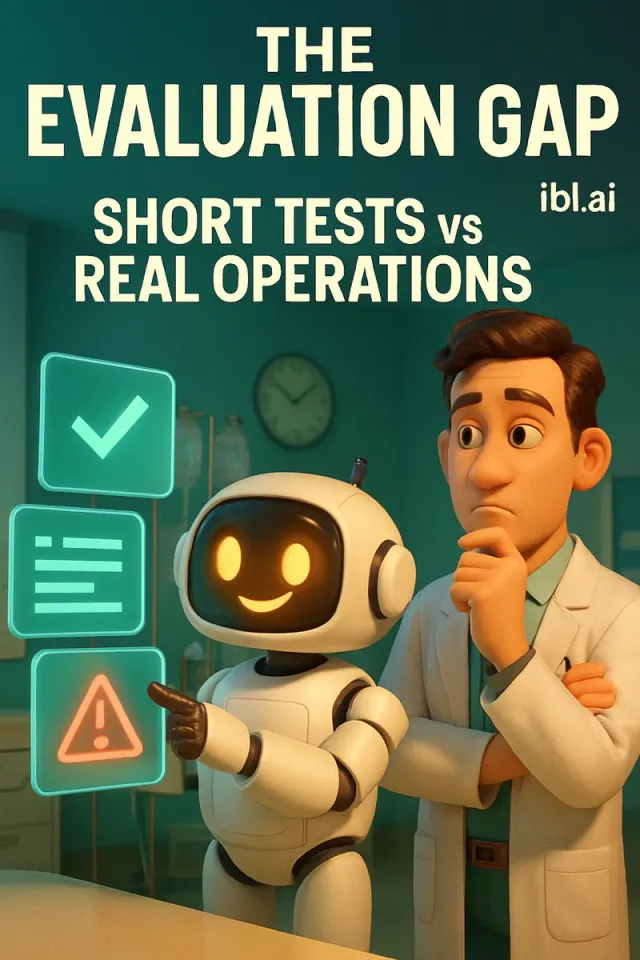
Hospital AI Aces Single-Turn Tests. Grade the Actions
In Stanford's MedAgentBench, the best overall model completed every one-step EHR task but 23.33% of tasks needing three or more steps, and scored lower on tasks that change a record than on tasks that only read one. A redesigned agent from a team including the original authors later reached 96.67% on its multi-tool-call tasks. Reliability belongs to the agent you deploy, so test it by step count and repeated runs, and gate every write to the record.
Mistral Large 4 (Le Chonk): The Infrastructure Math
Mistral Large 4 launched as a public preview API on 6 October 2026, a 1.05T-parameter mixture-of-experts model with 52B active, with weights promised by the end of October. This post does the memory and cost arithmetic for self-hosting it next to Aleph Alpha's 78B Kolibri, and explains why an API-first, weights-later release rewards a platform that can move a workload between the two.
PE Firms Put AI Agents in Healthcare. The Data Comes First
Private equity sponsors are putting AI agents into healthcare revenue cycle companies, from R1 under TowerBrook and CD&R to New Mountain's Smarter Technologies. The most specific sponsor-published result we found, Partners Group's 120 bps margin uplift at an insurance brokerage, was built on a clean proprietary dataset, and KPMG lists fragmented, unstructured data among the main bottlenecks. The data is the prerequisite, and who owns it decides what is left at exit.
Enterprise Agent Security: What Actually Shipped in 2026
Agent security stopped being a policy conversation and became production infrastructure over five months of 2026, not in a single week. This post gives the real dates for Uber's ADR, Microsoft Entra Agent ID, OpenAI's textGrain and Google's Gemini agent, maps each human-era control to what replaces it, and shows that the enforcement tier is the part vendors withhold.
Super Intelligence Force: What Changes for Agencies Buying AI
President Trump announced the Super Intelligence Force on 4 October 2026, a task force chaired by DNI Jay Clayton with 120 days to report on AI's risks and opportunities. Its reported charter covers AI threats and recommendations, not contracting; agencies still buy AI chiefly under OMB M-25-22, whose terms already reward data rights, portability and code an agency can keep.
Keep reading
Agentic AI Blog →
All 1050 articles on agent architectures, LLM infrastructure, and what it costs to run AI you actually own.
Platform Updates →
All 47 releases across the applications, the infrastructure tooling, and the open source repositories behind them.
Combined RSS feed →
This same merged stream as RSS — the 50 most recent items, articles and releases together.
ibl.ai publishes two things: analysis of how agentic AI is actually deployed, and the release notes for the platform we build. This page merges both so you can see what changed without checking two archives. ibl.ai is family-owned and operated from New York, NY, and the platform is model-agnostic and self-hosted — run any LLM, on any cloud, in your VPC, on-premise, or fully air-gapped, and you own all the code and the data.