One ontology over every system, for any agent
The knowledge layer a firm's AI agents work from: matters, clients, deadlines and invoices from the matter system and billing, certified once and served over MCP from a server in your network. On ibl.ai you own all the code and the data, run it model-agnostic across any LLM, and pay with no per-seat pricing — so you can deploy anywhere, from your own cloud to a fully air-gapped network. No need to choose build vs. buy — you get both.







“ibl.ai does amazing work and are great people.”
Prefer to build together? Our AI Transformation team builds agents and apps with yours, on your systems.
What makes it agentic
Not a data warehouse and not a copy of your data. ibl.ai's Agentic Ontology reads the systems you already run in place, names the business terms inside them, and serves the terms your people certify to any agent over MCP.
How is Agentic Ontology different from a managed knowledge layer?
A managed AI vendor's knowledge layer usually means copying your data into the vendor's cloud and renting access to a model of your own organization. Agentic Ontology runs on your server, reads your systems where they are, and the code is yours.
| Agentic Ontology | A managed knowledge layer | |
|---|---|---|
| Where the data goes | Agentic OntologyRead in place by a server in your network; the ontology, passwords and MCP servers stay there. | A managed knowledge layerCopied into the vendor's cloud. |
| Who holds the code | Agentic OntologyYou do: MIT-licensed, built from source on your own server. | A managed knowledge layerThe vendor; you rent access. |
| What an agent can run | Agentic OntologyCertified tools with fixed definitions and fixed SQL; raw SQL only if you add that toolset. | A managed knowledge layerWhatever the vendor's connector exposes. |
| Who sees what | Agentic OntologyOne ibl.ai policy per toolset, callers signed in by ibl.ai, Entra ID or your own OIDC issuer, every call logged. | A managed knowledge layerThe vendor's accounts and service keys. |
| Which agents | Agentic Ontologyibl.ai agents, Claude, Codex, Cursor or any MCP client. | A managed knowledge layerThe vendor's own assistant. |
| Pricing | Agentic OntologyThe ontology is MIT-licensed; the ibl.ai platform is usage or a flat license, with no per-seat pricing. | A managed knowledge layerPer seat, per connector, per year. |
What is ibl.ai's Agentic Ontology?
Agentic Ontology is ibl.ai's on-premise knowledge layer: it connects the databases and HTTP APIs your organization already runs, turns them into one set of business terms that your people certify, and publishes those terms as MCP servers any agent can call, from a server inside your network where you own all the code and the data.
It is open source under the MIT license and built from the public source on your own Ubuntu server. The ibl.ai platform supplies sign-in, roles, API keys and agents; your server keeps the ontology, the database passwords and the MCP servers.
An agent never gets arbitrary SQL unless you add the raw toolset: each certified term becomes a tool with a fixed definition and fixed SQL, and each caller sees only the toolsets its grant reaches.
MCP Architecture Guide for Legal
How to connect your legal systems (document management, case management, billing, research) to AI agents — step by step.
Read the GuideHow does the ibl.ai ontology turn your systems into tools an agent can call?
Five steps, one page of the ibl.ai ontology console each. The screenshots come from the console's demo mode, which serves fixed sample data, so every name and address in them is made up. Select a screenshot to enlarge it.
Step 1 · Systems
Connect
Add a SQL connection or an HTTP API connection. SQL connections use a read-only login, credentials are tested before they are saved, and the password is kept on your server and nowhere else.
Step 1, Connect: the Systems page. Select to enlarge. Step 2 · Map
Dissect
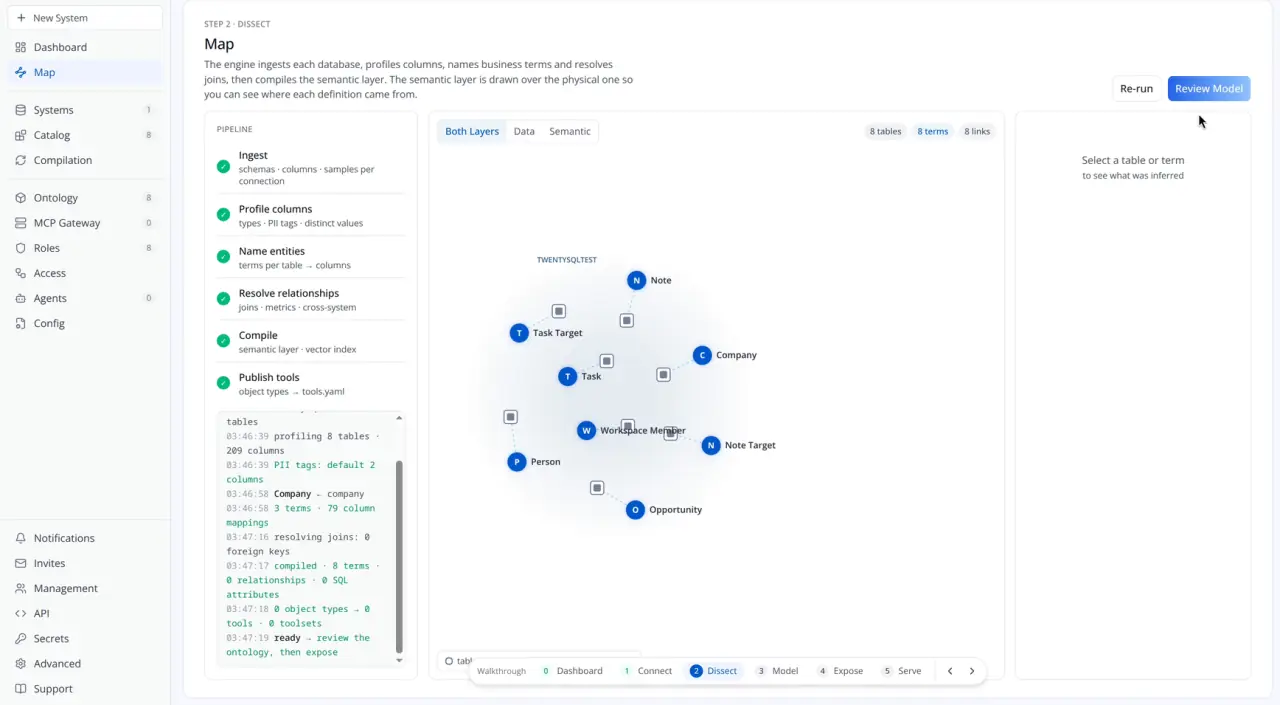
The engine reads the tables, profiles the columns and names the business terms above them. The Map draws that semantic layer over the physical one, so you can see which tables each definition came from.
Step 2, Dissect: the Map page. Select to enlarge. Step 3 · Ontology
Model
Review what was inferred and certify it: object types, their properties, links and metrics. Personal columns are flagged, and only the definitions you certify are compiled into tools.
Step 3, Model: the Ontology page. Select to enlarge. Step 4 · MCP Gateway, New MCP Server
Expose
Pick the toolsets, how callers sign in, and the origins and hosts allowed to reach the server. The config file is shown exactly as it will be written to your server, before anything is deployed.
Step 4, Expose: the MCP Gateway, New MCP Server page. Select to enlarge. Step 5 · MCP Gateway, the server
Serve
Deploy, attach the server to an ibl.ai agent with a key of its own, or paste a ready-made snippet into Claude, Codex or Cursor, then watch the calls arrive. Each server keeps its revisions, and Roll Back restores the last one.
Step 5, Serve: the MCP Gateway, the server page. Select to enlarge.


Built on NVIDIA and Google. NVIDIA's auto-ontology engine infers the terms and Google's MCP Toolbox serves the tools, both running on your own server beside the ibl.ai console.
How do you install the ibl.ai ontology and connect a database to an agent?
Install the Ontology on Your Own Server and Connect a Database to an Agent (12:39, YouTube)
A 12-minute walkthrough on the ibl.ai YouTube channel, from a fresh Ubuntu server to an ibl.ai agent answering questions about a CRM: the four-block install, connecting the CRM's database, the Map, publishing an MCP server and attaching it to the agent.
How does Agentic Ontology by ibl.ai work on the systems you already run?
Agentic Ontology by ibl.ai gives a law firm one set of definitions over the systems it already runs: a matter is the same matter in the matter system, billing and the docketing calendar.
It reads those databases and HTTP APIs in place, your team certifies the terms it finds, and each caller sees only the toolsets its grant reaches.
Open source under the MIT license, and yours, including full code access.
What problem does the ibl.ai ontology solve for AI agents?
What does the ibl.ai ontology model for a law firm's systems?
Which systems can the ibl.ai ontology connect?
Which AI agents can call the ibl.ai ontology's MCP servers?
How does the ibl.ai ontology control what each person and agent can see?
How do you install and run the ibl.ai ontology on your own server?
Why run the ibl.ai ontology instead of a managed vendor's knowledge layer?
How does the ontology fit into the rest of the ibl.ai platform?
How can you try the ibl.ai ontology today?
Free
Get started
$0per
monthNo credit card required
Get Started FreeThis includes:
- Monthly credits to try agents, renewed each month
- Build agents on any model, trained on your own documents
- Chat on web, desktop and mobile
- Documentation and community support
For one person trying things out
- Most popular
Pro
For everyday work
$15per
monthBilled monthly
Subscribe to ProEverything in Free, plus:
- More credits every month, with auto-recharge when you want it
- Voice, workflows and your tools through MCP
- Analytics, embedding and the API
- Email support
For professionals and small teams running agents every day
Max
For all-day work
$50per
monthBilled monthly
Subscribe to MaxEverything in Pro, plus:
- A much larger monthly credit allowance
- Evaluations, spend limits and monetization
- Roles and teams for access control
- Priority support and early access
For teams and departments that depend on agents
Ultra
For your largest deployments
$100per
monthBilled monthly
Subscribe to UltraEverything in Max, plus:
- The largest monthly credit allowance
- Several organizations and single sign-on
- Hand-off to human agents
- Dedicated support and hands-on onboarding
For organizations formalizing agents across many teams
- Recommended
This includes:
- Full codebase ownership under a perpetual license
- Deploy anywhere — on-prem, your VPC, air-gapped, or managed SaaS
- Start with a pilot — prove value on real data first
- Custom AI engineering — integrations, SSO, SIS, LMS, agents
- Run any LLM — Claude, GPT, Gemini, Llama; switch anytime
- SOC 2 & compliance — enterprise security with audit support
Enterprise — Own the Platform. Own the entire platform. We transfer the full source under a perpetual license and deploy it on-premise, in your cloud, or air-gapped — zero vendor lock-in, run any LLM. Start with a pilot, then scale with our engineers wiring it into your data and systems.
Self-serve prices in USD, billed monthly; change or cancel your plan anytime from Billing in the app. Enterprise is scoped with our team: a pilot from $15K, a one-time deployment, or full codebase ownership on a custom quote.
What our partners say about us

Chris Gabriel | Google

Lorena Barba | George Washington University

Dr. Juana Mendenhall | Morehouse College

Juile Diop | MIT

Adam Tetelman | Nvidia

Jason Dom | American Public University System

Benjamin Breyer | Columbia University

Ken Fujiuchi | SUNY

Erika Digirolamo | Monroe College

David Flaten | SUNY

David Vise | Modern States Education Alliance

Linda Wood | ARM Institute (U.S. Department of Defense)
Chris Gabriel | Google
Lorena Barba | George Washington University
Dr. Juana Mendenhall | Morehouse College
Juile Diop | MIT
Adam Tetelman | Nvidia
Jason Dom | American Public University System
Benjamin Breyer | Columbia University
Ken Fujiuchi | SUNY
Erika Digirolamo | Monroe College
David Flaten | SUNY
David Vise | Modern States Education Alliance
Linda Wood | ARM Institute (U.S. Department of Defense)
Frequently Asked Questions
Agentic Ontology is ibl.ai's on-premise knowledge layer. It connects the databases and HTTP APIs an organization already runs, names the business terms and relationships inside them, and publishes the terms your people certify as MCP servers that any agent can call.
It is open source under the MIT license (github.com/iblai/ontology).
No. The ontology runs on a server inside your network and reads your systems in place. The ontology, the database passwords and the MCP servers stay on that server, and the console keeps no database of its own.
PostgreSQL, MySQL, Snowflake and ClickHouse are dissected into terms and served as tools. Any system with an HTTP API can be served as tools today, from an OpenAPI document or endpoints you name.
Trino and Databricks are mapped but not served; DuckDB, HeavyDB, Kyuubi, SQLite, SQL Server, Oracle and BigQuery are coming soon.
Not by default. SQL connections use a read-only login. With an HTTP API connection you can choose to allow writes: those endpoints go in a toolset of their own, which an agent reaches only when you grant it by name.
ibl.ai agents, attached in one dialog with a key of their own; Claude Desktop and Claude Code; Codex CLI; Cursor and Windsurf; your own code with the MCP SDK; and cURL. Each caller sees only the toolsets its grant reaches.
No. Connecting a system, the Map, certifying terms and the tools all work without one. An OpenAI API key, or any gateway that speaks OpenAI's API, turns on inferred joins and questions in plain words.
Ubuntu 22.04, 24.04 or 26.04 on x86-64, 4 GB of memory, 15 GB free and ports 80 and 443 open. The install is four blocks to paste, and the console is built on the server from the public source.
You do. The ontology is MIT-licensed and runs on your server; the ibl.ai platform it signs in with is priced on usage or a flat license, with no per-seat pricing. On ibl.ai you own all the code and the data.
Bring us a hard problem. Keep the code.
Run Agentic Ontology on your own terms
Start free on our cloud today, or take the whole codebase into your own infrastructure. Either way our engineers work alongside your team, and you own all the code and the data.
ibl.ai is family-owned and operated from New York, NY — a U.S.-headquartered, domestically-owned long-term partner, not a vendor that sells licenses and moves on. · SOC 2 Type II certified