/iblai-vibe-credit-exhaustion
Mirrored from
iblai/base·skills/billing/iblai-vibe-credit-exhaustion/SKILL.md. This page is generated — edit it in the repository, not here.
What the app shows when the organization's ibl.ai credits are spent, and
before that, when a free-trial user reaches for something only a workspace
owner may do. The decision is the SDK's (use402ErrorCheck in
@iblai/iblai-js/web-utils); it only flips flags on the store. This skill is
where those flags become screens — the plan picker, the Billing page, a
contact-your-admin notice — for everything on the page: the in-process
<Chat>, the navbar widget, the app's own REST calls, and an OS agent
embedded with <agent-ai>. vibe-starter ships it.
Common setup (brand, conventions, env files, verification): see docs/skill-setup.md.
How the SDK decides
Every 402 (a chat message, a training run, any call the credits ledger
refuses) goes through handle402Error. It shows one toast, then opens the
one thing that person can do next:
| Who ran out | Toast | Next step |
|---|---|---|
| An admin of the organization | "You've run out of credits. Add credits to continue." | openBillingTab from SubscriptionConfigProvider — vibe-starter sends them to /admin/billing (/iblai-vibe-billing); the OS opens its profile modal on Billing (?profileTab=billing) |
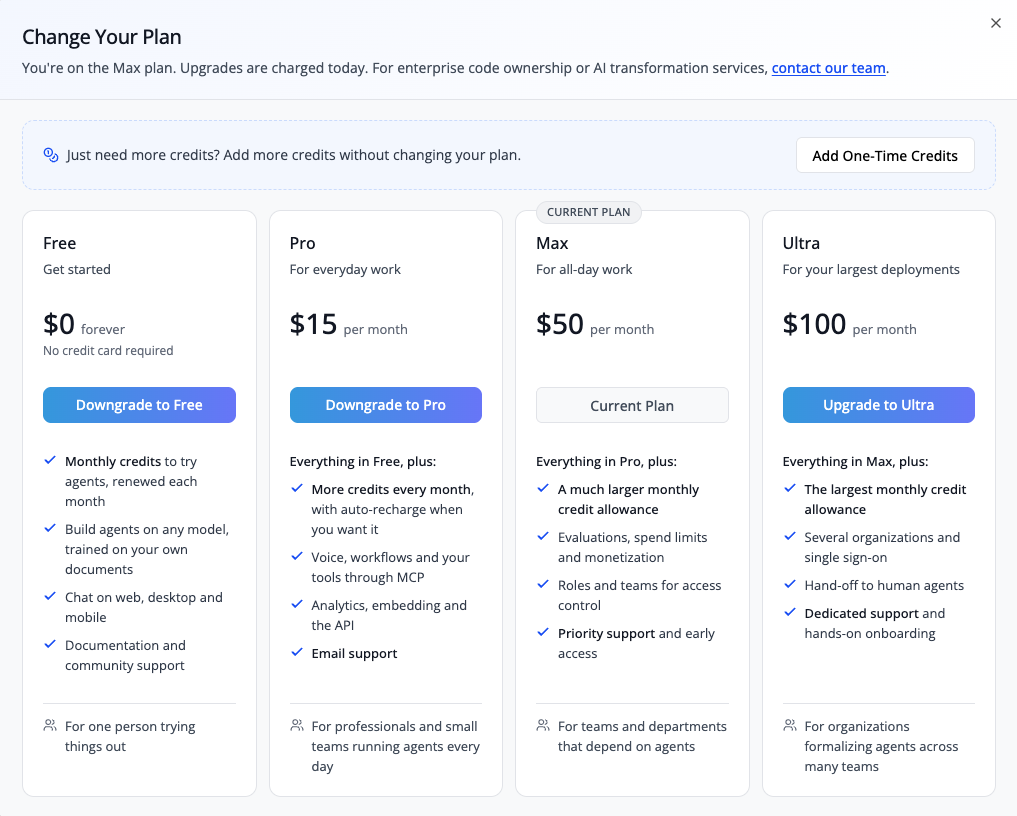
A free-trial user — signed up on the platform's main organization (main) and in no other (the backend sends a pricing_table only to the account owner; useUserIsOnTrial is the fallback) | "You've run out of your free trial credits. Pick a plan to continue." | UpgradePackageModal — Choose Your Plan: Free ($0, no card, their own workspace), Pro, Max, Ultra, with a "contact our team" line for enterprise |
| Everyone else (a member) | "Your organization has run out of credits." | ContactAdminModal — one line and a Contact Now button that mails the organization's support address |
| A desktop/iOS build that may not sell in-app (Apple's rules) | — | AppleRestrictionModal instead of any checkout |
The free trial lives on the platform's main organization (main on hosted
ibl.ai, the SDK's default mainTenantKey), the only one that lists and
changes plans. A single-organization app on its own organization has no
free-trial users: there, a non-admin gets the picker only when the 402
carries a pricing_table, and an organization already on a plan meets it as
Change Plan (the navbar widget, Billing).
Two more things read the same store: the free-trial gate (Step 3) sends a
trial user to the plan picker before an admin action instead of letting it
fail, and the top banner (SubscriptionTopBanner) carries the
"credits exhausted" line with its own button. Nothing here charges anyone —
plans and credits are bought on Stripe through the ibl.ai backend
(/iblai-vibe-credit, /iblai-vibe-billing).
What you get
components/credit-exhaustion-handler.tsx(assets/): rendersUpgradePackageModal,ContactAdminModalandAppleRestrictionModalfrom the store, and listens for an embedded agent'screditsexhaustedevent. Mounted once inapp/(app)/layout.tsx.SubscriptionConfigProviderin the provider chain, with the credits switch, support address, plan bullets and where Billing lives (the main organization stays the SDK's default: the platform's, not the app's); thesubscription,topBannerandappleRestrictionslices in the store.config.stripeEnabled()andconfig.planFeatures()inlib/iblai/config.tsfromNEXT_PUBLIC_STRIPE_ENABLEDandNEXT_PUBLIC_PLAN_FEATURES_*.components/embedded-agent.tsx(assets/, optional): the OS agent in an iframe with the hand-off turned on (live once the OS ships iblai/os#677).- vibe-starter ships all of it but the embed;
/iblai-vibe-authinstalls the store and providers on an existing app.
When to use / when not
| Use it for | Not for |
|---|---|
| Any app whose organization is billed in credits (every self-serve organization) | Charging your users — /iblai-vibe-pricing picks that rail |
An OS agent embedded with <agent-ai> whose picker should open at page size | The in-process <Chat> alone: it already calls these flows; you still need Step 2 so its modals have somewhere to render |
The navbar widget's Upgrade / Change Plan (/iblai-vibe-credit) and the Billing page (/iblai-vibe-billing) — same picker, same store | Spend caps (a 429, not a 402): /iblai-vibe-agent-billing |
Prerequisites
- Auth in place (
/iblai-vibe-auth, or vibe-starter). @iblai/iblai-js@^2.80.0: the credits flows, the plan picker and its bullets arrived in 2.73.0, the host side of the embed hand-off in 2.79.0. For the embed itself,@iblai/agent-ai@^2.15.0and the OS release that carries iblai/os#677 (Step 5).- An organization on the credits model: the main organization's sign-up is a free trial; a workspace created from the picker is on a plan.
Step 1: The store slices and the host config
The flows read the subscription status from the store and write the modal
flags to it. The reducer map needs these three keys, under exactly these
names (vibe-starter's store/iblai-store.ts):
reducer: {
  // … chat, chatInput, chatSliceShared, files, rbac, coreApiSlice, mentorReducer
  subscription: subscriptionReducer,
  topBanner: topBannerReducer,
  appleRestriction: appleRestrictionReducer,
}
Then tell the SDK about the app, once, above everything that renders
(vibe-starter does it inside providers/iblai-providers.tsx; on an app with
its own provider chain, wrap it):
// providers/credits-config.tsx
"use client";

import { useMemo, type ReactNode } from "react";
import { useRouter } from "next/navigation";
import { SubscriptionConfigProvider } from "@iblai/iblai-js/web-utils";
import config from "@/lib/iblai/config";

export function CreditsConfig({ children }: { children: ReactNode }) {
  const router = useRouter();
  const value = useMemo(
    () => ({
      // No `mainTenantKey`: the SDK's default, `main`, is the platform's main
      // organization — not this app's (NEXT_PUBLIC_MAIN_TENANT_KEY).
      // The credits switch: off, and nothing gates or prompts for credits.
      stripeEnabled: config.stripeEnabled(),
      // Fallback for Contact Now when the organization's metadata has none.
      supportEmail: config.supportEmail(),
      // The plan picker's bullets, by plan key (Step 4).
      planFeatures: config.planFeatures(),
      // An admin who ran out of credits: this app's Billing page.
      openBillingTab: () => router.push("/admin/billing"),
    }),
    [router],
  );
  return <SubscriptionConfigProvider config={value}>{children}</SubscriptionConfigProvider>;
}
Every field has a default, so the hooks work without the provider: billing
on, openBillingTab pushing ?profileTab=billing for the OS's profile
modal (set those), and mainTenantKey: "main", the platform's main
organization — where free-trial users live and the only one that lists and
changes plans. Leave that one alone. It is not your app's organization: with
NEXT_PUBLIC_MAIN_TENANT_KEY in the slot, Change Plan is refused (404,
"Only the main platform offers plan changes"), every admin sees the credit
balance whether or not the organization sells credits, and the free-trial
gate sends every member to the picker. Read it back with
useSubscriptionConfig().mainTenantKey wherever a component takes
mainPlatformKey.
Step 2: Mount the handler
Copy assets/credit-exhaustion-handler.tsx to
components/credit-exhaustion-handler.tsx and render it once inside the
signed-in layout, next to the navbar:
// app/(app)/layout.tsx — inside the signed-in layout, beside the navbar
<NavBar … />
<NavigationDrawer … />
{/* The plan picker / contact-admin notice the SDK opens when credits run out. */}
<CreditExhaustionHandler />
What it does: use402ErrorCheck() gives it handle402Error; it renders the
three modals whenever state.subscription.openPricingModal,
state.subscription.openContactAdminModal or
state.appleRestriction.openAppleRestrictionModal is set; and it listens on
document for the creditsexhausted event (the providers below, Step 5),
dropping a repeat within a second — one REST 402 reaches the data layer's
handler twice. The picker's mainPlatformKey is the provider's
mainTenantKey, sourcePlatformKey the current organization, and its
redirectUrl the login page with the app nested inside
(<auth>/login?app=custom&redirect-to=<origin>): the checkout appends a
sign-in token the login page consumes before returning to the app, and the
pricing session refuses a return URL on a domain it does not allow, which an
app's own domain is not (400 "Redirect URL domain is not allowed"). That URL
is loginReturnUrl() in lib/iblai/auth-utils.ts; /iblai-vibe-auth
installs it, and an older copy of the file needs it added:
// lib/iblai/auth-utils.ts
import config from "@/lib/iblai/config";

/** The login page with this app nested inside: where a checkout returns the person. */
export function loginReturnUrl(origin: string = config.appUrl()): string {
  return `${config.authUrl()}/login?app=custom&redirect-to=${encodeURIComponent(origin)}`;
}
Then route the app's own REST 402s the same way. The data layer takes one
handler per status; vibe-starter's providers/iblai-providers.tsx passes
it to initializeDataLayer, dispatching the same event the handler already
listens for, so one component shows the next step:
// the httpErrorHandler argument of initializeDataLayer(...)
const httpErrorHandler = {
  402: (error?: unknown) => {
    // The data layer hands over the 402's body itself (spread) or, on its
    // legacy-LMS path, `{ status, body, message }`.
    const raw = (error ?? {}) as Record<string, unknown>;
    const body = (raw.body && typeof raw.body === "object" ? raw.body : raw) as Record<string, unknown>;
    // An item paywall's 402 (`has_access`, `pricing`) belongs to the
    // monetization flows; a credits 402 carries the backend's sentence.
    if ("has_access" in body || "item_type" in body || "pricing" in body) return;
    document.dispatchEvent(
      new CustomEvent("creditsexhausted", { detail: { type: "credits.exhausted", ...body } }),
    );
  },
};
<Chat> needs nothing more: its default on402Error is this same hook
(navigateToAdminBilling in its config is the admin's step), and now its
modals have a place to render. A host-owned dialog through
config.freeTrialDialog is no longer needed.
Step 3: Gate admin actions for free-trial users
A free-trial user may chat; creating an agent, inviting people or opening
Management is for a workspace owner, so the OS offers them a plan first.
Wrap such actions in the SDK's gate. It runs the action when the person may
take it; otherwise it opens their next step and returns null:
// components/new-agent-button.tsx
"use client";

import { useRouter } from "next/navigation";
import { useShowFreeTrialDialog } from "@iblai/iblai-js/web-utils";

export function NewAgentButton() {
  const router = useRouter();
  const { executeWithTrialCheck } = useShowFreeTrialDialog();
  return (
    <button
      type="button"
      className="ibl-button-primary inline-flex items-center rounded-lg px-4 py-2 text-sm font-medium"
      onClick={() => executeWithTrialCheck(() => router.push("/setup"))}
    >
      New agent
    </button>
  );
}
executeWithTrialCheck(action, isAdminAction = true): pass false for
things every signed-in person may do (then only "credits exhausted" blocks
it). isNewlyUserOnPreFreeOrAdvertisingMode(true) is the predicate alone —
the OS and the LMS use it to show the whole admin menu to a trial user and
open the picker on click, instead of hiding the menu. <Chat> exposes the
same gate as config.onUpgradeRequired.
The predicate asks whether the current organization is the platform's main one (or an advertising one) and the person is not its admin; it does not count the person's organizations. On an app's own organization it is false for everyone, so the gate blocks only on exhausted credits; on the main organization it sends every non-admin to the picker.
Step 4: The plan picker's bullets
Each card's bullets come from the host, so an app describes the plans in
its own words. config.planFeatures() reads four |-separated env
variables (**text** shows in bold); premium is the Pro plan's key. An
empty variable keeps the SDK's built-in bullets. vibe-starter's
.env.example carries the OS's:
NEXT_PUBLIC_STRIPE_ENABLED=true
NEXT_PUBLIC_PLAN_FEATURES_FREE="**Monthly credits** to try agents, renewed each month|Build agents on any model, trained on your own documents|Chat on web, desktop and mobile|Documentation and community support"
NEXT_PUBLIC_PLAN_FEATURES_PRO="**More credits every month**, with auto-recharge when you want it|Voice, workflows and your tools through MCP|Analytics, embedding and the API|**Email support**"
NEXT_PUBLIC_PLAN_FEATURES_MAX="**A much larger monthly credit allowance**|Evaluations, spend limits and monetization|Roles and teams for access control|**Priority support** and early access"
NEXT_PUBLIC_PLAN_FEATURES_ULTRA="**The largest monthly credit allowance**|Several organizations and single sign-on|Hand-off to human agents|**Dedicated support** and hands-on onboarding"
Names, taglines, prices and intervals are not yours to set: the backend
resolves them from the organization's Stripe payment links
(GET …/stripe/pricing-page-session/ → plans[]). Keep the bullets
industry-neutral unless the app is for one audience — the LMS lists
courses and cohorts, the OS lists agents and workflows.
Step 5: An embedded OS agent
Not live yet. The OS sends the
credits.exhaustedframe only from iblai/os#677, which is still open: OSmainposts nothing for a 402. Until that release the attribute is accepted and the embed keeps its own modals; wire it now and the hand-off starts when the OS ships.
When the agent on the page is the OS itself in an iframe (<agent-ai> from
@iblai/agent-ai — the OS's own chat, sidebar and settings, signed in as
your user), a 402 would open the picker inside the widget. The
handlecreditexhaustion attribute hands it to the page instead:
- On load (and whenever the attribute changes) the element tells the agent
{ type: 'MENTOR:HANDLE_CREDIT_EXHAUSTION', data: true }. - On a 402 the agent still shows its toast, but instead of a modal it posts
{ type: 'credits.exhausted', audience: 'admin' | 'trial' | 'user', error, message, pricing_table }to the parent. - The element re-dispatches that frame as the
creditsexhaustedDOM event (detailis the frame; it bubbles and is composed) — the one the handler from Step 2 listens for — which feeds it to the host'shandle402Error: same routing, at page size.
Copy assets/embedded-agent.tsx to components/embedded-agent.tsx:
// components/embedded-agent.tsx — the element, with the hand-off on
"use client";

import { createElement, useEffect, useState } from "react";
import config from "@/lib/iblai/config";
import { resolveAppTenant } from "@/lib/iblai/tenant";

export function EmbeddedAgent({ agentId }: { agentId: string }) {
  const [ready, setReady] = useState(false);
  useEffect(() => {
    let active = true;
    // Registers <agent-ai>; a browser-only module, never at import time.
    void import("@iblai/agent-ai").then(() => {
      if (active) setReady(true);
    });
    return () => {
      active = false;
    };
  }, []);
  if (!ready) return null;
  return createElement("agent-ai", {
    authurl: config.authUrl(),
    lmsurl: config.legacyLmsUrl(),
    tenant: resolveAppTenant(),
    mentor: agentId,
    authRelyOnHost: true,       // signed in as this app's user
    handleCreditExhaustion: true, // the 402's next step opens here, not in the widget (from the OS release with iblai/os#677)
    theme: "light",
    style: { display: "block", width: "100%", height: "100%" },
  });
}
authRelyOnHost makes the embed use the session this app's SSO stored and
never redirect to the login page on its own. Self-hosting the OS? Add
mentorurl with its origin. The raw postMessage reaches window too, for
a host without a handle on the element. The wire contract is in
/iblai-api-agent-embed (references, §5).
Verify
pnpm buildandpnpm testpass;pnpm e2e:coveragelists the checkpoint below.- Touch test as
/iblai-vibe-ops-testsays, signed in as an admin: in the browser console rundocument.dispatchEvent(new CustomEvent('creditsexhausted', { detail: { type: 'credits.exhausted', audience: 'admin' } }))— a toast, then/admin/billing. Signed in as a member of the same organization: the "Your organization has run out of credits" dialog, and Contact Now opens a mail draft. A user who signed up moments ago (a free trial, on the platform's main organization): the "Choose Your Plan" dialog with four cards and your bullets; console clean; no sideways scroll at phone width. - The real thing needs an organization with no credits left (ask an ibl.ai
operator to zero a test organization's balance): send a chat message —
the same screens, from a real 402. vibe-starter's checkpoints dispatch
the event by hand so the suite never spends credits: K10 (the admin lands
on Billing,
e2e/journeys/pages.journey.spec.ts), M6 (a member gets the notice) and M7 (apricing_tableopens the picker; both inmember.journey.spec.ts).
Customize
get_component_info("UpgradePackageModal")
get_component_info("ContactAdminModal")
get_hook_info("use402ErrorCheck")
get_hook_info("useShowFreeTrialDialog")
<UpgradePackageModal> — @iblai/iblai-js/web-containers:
| Prop | Type | Description |
|---|---|---|
open, onClose | boolean, () => void | The dialog's state (vibe-starter binds state.subscription.openPricingModal) |
redirectUrl | string | Where Stripe sends the person back after checkout: the login page with the app's origin nested (loginReturnUrl()); the pricing session refuses a domain it does not allow |
sourcePlatformKey, mainPlatformKey | string | The current organization and the platform's main one (useSubscriptionConfig().mainTenantKey) |
currentUserEmail | string | Pre-fills Stripe Checkout |
currentPlanKey | string | null | Change mode: that card reads "Current Plan", the others offer an upgrade or a downgrade. Leave unset for a free-trial user |
planFeatures | Record<string, string[]> | Bullets by plan key; defaults to the provider's (Step 4) |
enterpriseContactUrl | string | The "contact our team" link (default https://ibl.ai/contact; "" drops the sentence) |
onPlanChanged | (result) => void | Change mode: after updated / scheduled — refetch the billing info |
onAddCredits | () => void | Change mode: shows "Add One-Time Credits" under the plans |
checkoutUrl, ctaLabel, features, footerNote, title, description | string, string[] | One checkout link instead of the platform's plans — an app's direct join URL |
<ContactAdminModal> and <AppleRestrictionModal> take isOpen and
onClose. SubscriptionConfig: mainTenantKey, platformName,
mentorUrl, stripeEnabled, supportEmail, openBillingTab,
planFeatures — all optional, all defaulted.
Platform data
| Hook / call | Purpose |
|---|---|
use402ErrorCheck({ navigateToAdminBilling? }) → handle402Error(body) | The routing above; body is the 402's { error, message, pricing_table } |
useShowFreeTrialDialog() → executeWithTrialCheck, isNewlyUserOnPreFreeOrAdvertisingMode | The free-trial gate |
useUserIsOnTrial(), useIsStripeActivated() | One organization, the main one, not its admin, billing on; the credits switch for the current organization |
useSubscriptionConfig() | The provider's values (or the defaults) |
useStripeUpgrade({ … }) → plans, loadPlans, choosePlan, changePlan | What the picker calls; STRIPE_PLAN_KEYS = free, premium (Pro), max, ultra |
setOpenPricingModal, setOpenContactAdminModal, setOpenAppleRestrictionModal | The flags the handler renders from |
useGetAccountBillingInfoQuery | plan_key / plan_name (absent on a trial), credits, auto-recharge |
useGetStripePricingPageSessionQuery, useChangeStripePlanMutation | GET …/service/platforms/{org}/stripe/pricing-page-session/ (the plans list); POST …/stripe/plans/change/ { plan_key } → updated / scheduled / checkout |
| The 402 itself (REST only) | { "error": "…", "message"?: "…", "pricing_table"?: { pricing_table_id, publishable_key, client_reference_id } } — pricing_table only for the account owner on a trial |
All hooks from @iblai/iblai-js/web-utils, the queries from
@iblai/iblai-js/data-layer. REST reference:
/iblai-api-billing.
Important Notes
- Billing off (
NEXT_PUBLIC_STRIPE_ENABLED=false): no navbar widget, no trial gate, no plan picker from the widget. A 402 still toasts and routes (an admin to Billing, a member to the contact-admin notice) — the ledger does not know the switch. - Who is an admin:
is_adminon the current organization in the signed-in user'stenants, not your app's Admin/User switch. An admin browsing in User mode is still sent to Billing; vibe-starter's/admin/*is Admin-mode-only, so they land on the home page — open Billing from Admin mode. - The main organization is the platform's, not yours:
mainPlatformKeyeverywhere (the picker,CreditBalance,BillingTab, the navbar rule) isuseSubscriptionConfig().mainTenantKey, neverNEXT_PUBLIC_MAIN_TENANT_KEY(Step 1 says what goes wrong). - One place to render: the modals read the store, so a second
CreditExhaustionHandler(or the OS's ownModalContainerpattern beside it) would open twice. Mount it once, in the layout. - Spend caps are not credits: a blocked spend limit is a
429withspend_cap_exceeded, handled by<Chat>itself (/iblai-vibe-agent-billing). - Brand guidelines: BRAND.md
Related skills
/iblai-vibe-credit— the navbar widget: Upgrade / Change Plan / Add Credits/iblai-vibe-billing— the Billing page an admin lands on/iblai-vibe-pricing— how the organization is charged; charging your users/iblai-vibe-agent-chat—on402Error,onUpgradeRequiredon<Chat>/iblai-api-agent-embed— the embed's wire contract, including the credits frames/iblai-vibe-ops-build— the Apple in-app-purchase restriction on native builds