/iblai-vibe-agent-memory
Mirrored from
iblai/vibe·skills/agents/iblai-vibe-agent-memory/SKILL.md. This page is generated — edit it in the repository, not here.
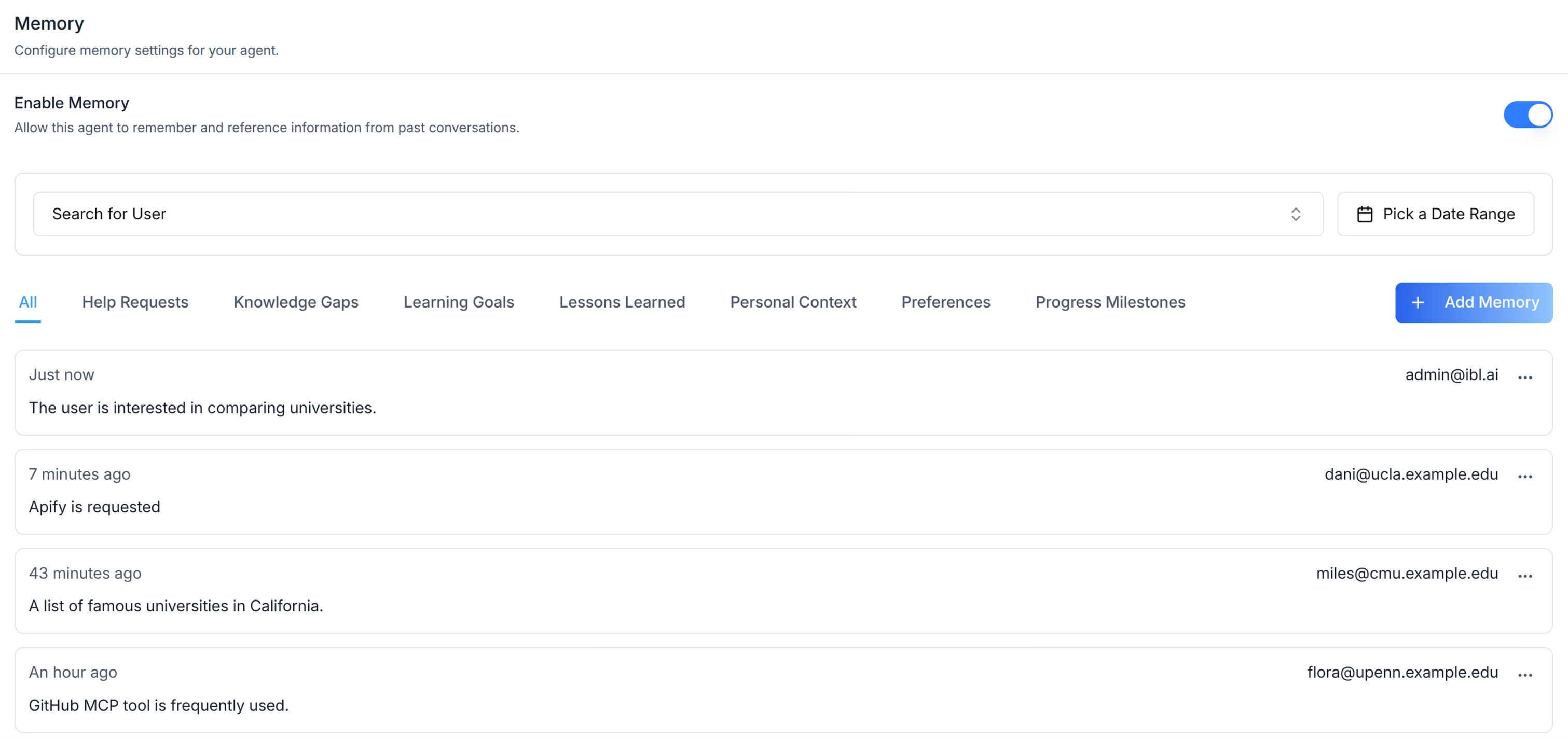
Add the agent Memory tab -- a Long-term Memory switch ("Let this agent remember useful details from past conversations — like a returning colleague — so people don't have to repeat themselves") and, while it is on, two sub-tabs:
- Personal Memories — what the agent remembered about each person: Search for User, Pick a Date Range, category tabs (All / Knowledge Gaps / Learning Goals / Personal Context / Preferences / …), a Categories manager, Add Memory, and a kebab per memory.
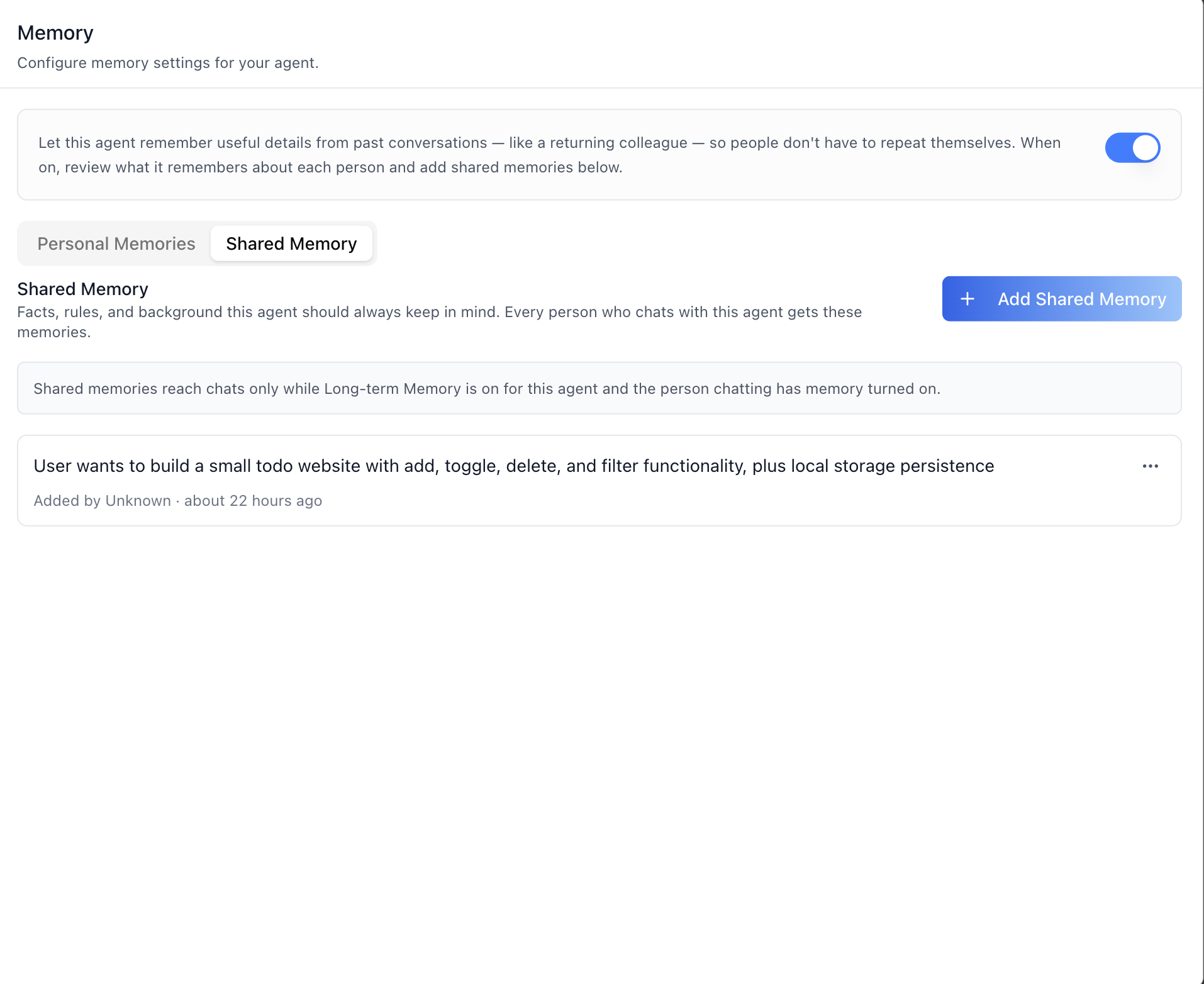
- Shared Memory — "Facts, rules, and background this agent should always keep in mind. Every person who chats with this agent gets these memories." Add Shared Memory, edit and delete, 20 per page.
Shared Memory is the UI for what the API calls agent knowledge
(agent-memories): one agent, no user, curated by hand, injected into
every chat with the agent as an ## Agent Knowledge block. This is one
tab in the wider agent-settings family; all tabs share the same
AgentSettingsProvider wrapper (optional for this tab — identity can be
passed as props).
Common setup (brand, conventions, env files, verification): see docs/skill-setup.md.
Related memory surfaces
/iblai-vibe-memory-guide— what memory means (three stores, three gates) and which surface to mount for which audience./iblai-vibe-memory— organization settings → Memory: any user's global memories and any agent's memories. Its Agent popup hosts the Personal Memories manager only; an agent's Shared Memory is managed here, on the agent's own tab./iblai-vibe-profile— the member's own Memory tab (their global memories and the two capture/recall toggles)./iblai-api-agent-memory— the REST twin, including the agent-knowledge endpoints behind Shared Memory.
Prerequisites
- Auth must be set up first (
/iblai-vibe-auth) - MCP server + skills configured (
@iblai/mcpin.mcp.json) AgentSettingsProviderwrapping the route (see/iblai-vibe-agent-settingStep 2), or passtenantKey/mentorId/usernameas props.- Ask the user for a real
mentorId(agent UUID). Do NOT invent one. - Memory must be on for the organization (
enable_memsearch). The switch on this tab is the agent gate; the person chatting must also have memory turned on. All three gates must be open before anything on this tab reaches a chat — see the guide.
Step 1: Check Environment
Before proceeding, check for an iblai.env in the project root. Look for
PLATFORM, DOMAIN, and TOKEN variables. If the file does not exist or
is missing these variables, tell the user:
"You need an iblai.env with your platform configuration. Download the
template and fill in your values:
curl -o iblai.env https://raw.githubusercontent.com/iblai/vibe/refs/heads/main/iblai.env"
Step 2: Mount AgentMemoryTab
// app/(app)/agents/[mentorId]/memory/page.tsx
"use client";

import { AgentMemoryTab } from "@iblai/iblai-js/web-containers/next";

export default function AgentMemoryPage() {
  return (
    <div className="flex h-full flex-col bg-white">
      <AgentMemoryTab />
    </div>
  );
}
The tab reads tenantKey, mentorId, username, enableRBAC and
rbacPermissions from the nearest <AgentSettingsProvider>, loads the
agent settings for the switch, and renders both sub-tabs under it.
With identity overrides
When the tab is not rendered inside an <AgentSettingsProvider>, pass
identity explicitly:
<AgentMemoryTab
  tenantKey="my-tenant"
  mentorId="00000000-0000-0000-0000-000000000000"
  username="learner@example.com"
/>;
Step 3: Customize Labels (Optional)
import { AgentMemoryTab } from "@iblai/iblai-js/web-containers/next";

<AgentMemoryTab
  labels={{
    header: { title: "Mentor memory" },
    subTabs: { personal: "About each person", shared: "Always in mind" },
    sharedMemory: {
      addButton: "Add a standing fact",
      empty: { title: "Nothing shared yet" },
    },
  }}
/>;
Step 4: Use MCP Tools for Customization
get_component_info("AgentMemoryTab")
get_component_info("AgentSettingsProvider")
get_hook_info("useGetSharedMemoriesQuery")
<AgentMemoryTab> Props
Import from @iblai/iblai-js/web-containers/next.
| Prop | Type | Required | Description |
|---|---|---|---|
labels | DeepPartial<MemoryTabLabels> | No | Override user-visible strings — header, the switch (toggle), subTabs, the whole sharedMemory bundle (list, empty/denied states, both dialogs, errors, toasts), and the switch toasts |
tenantKey | string | No | Identity override. Defaults to the nearest <AgentSettingsProvider> |
mentorId | string | No | Agent UUID override. Defaults to the provider |
username | string | No | Username override. Defaults to the provider |
enableRBAC | boolean | No | Honor the RBAC permission tree for the switch and the Shared Memory writes. Defaults to the provider value or false |
rbacPermissions | object | No | The permission tree from your RBAC slice. Defaults to the provider value |
What the tab renders
Long-term Memory switch
The in-tab switch flips enable_memory_component on the agent
(optimistically, rolled back with a toast if the save fails). While it is
off both sub-tabs stay visible but inert, with the hint "Turn it on
to let this agent remember details across conversations." — the backend
injects neither personal nor shared memories into chats while the flag
is off.
Personal Memories
The same manager the organization's Memory admin opens per agent: Search for User (server-side), Pick a Date Range, category tabs (All plus the agent's categories — Knowledge Gaps, Learning Goals, Personal Context, Preferences, … by default), a Categories manager (create / rename / delete categories and their extraction prompts), Add Memory, and per-memory cards showing the time-ago, the owning user's email and an Edit / Delete kebab.
Shared Memory
- Header: "Shared Memory — Facts, rules, and background this agent should always keep in mind. Every person who chats with this agent gets these memories." and the Add Shared Memory button.
- An info box: "Shared memories reach chats only while Long-term Memory is on for this agent and the person chatting has memory turned on."
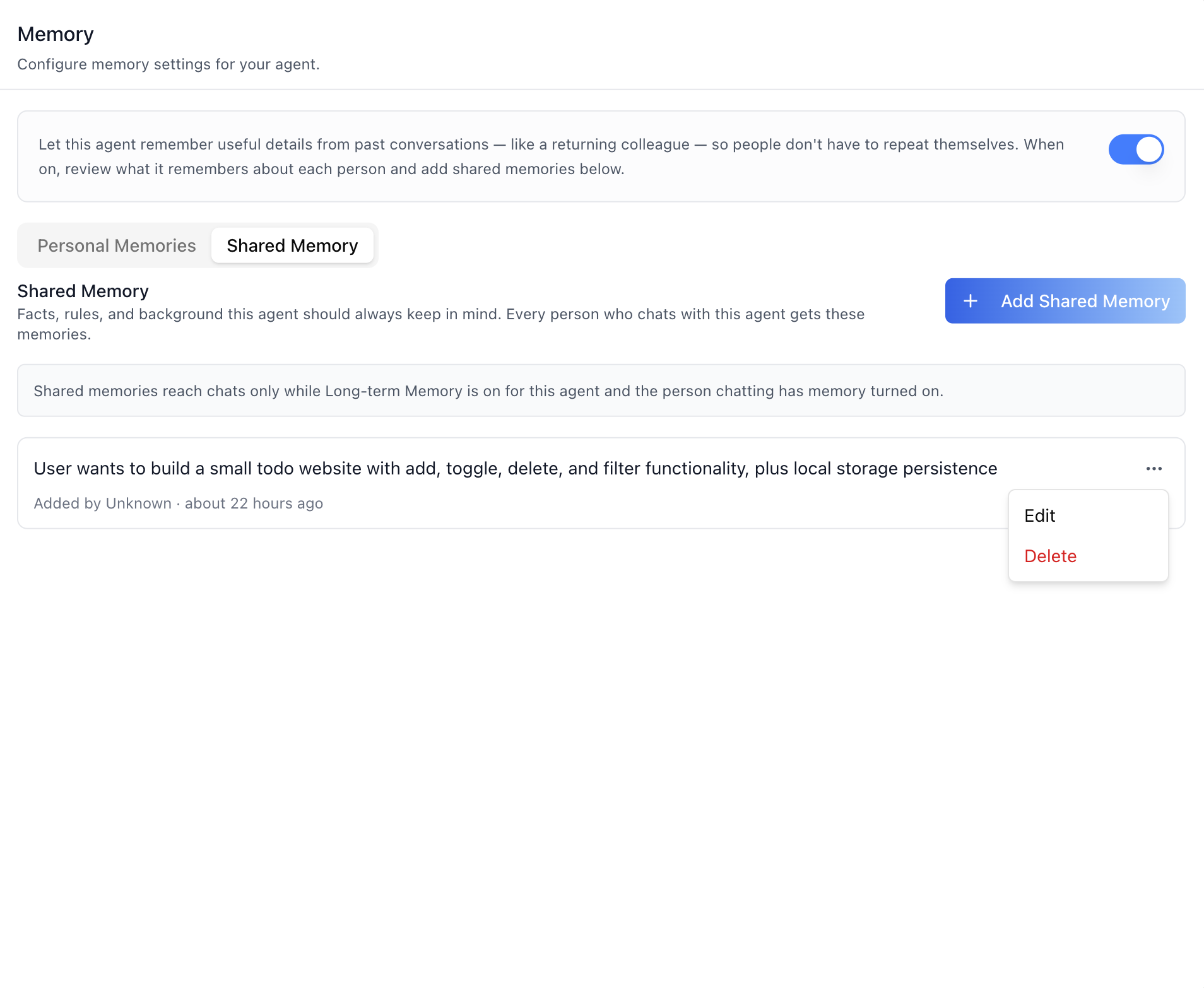
- One card per entry: the text, then "Added by {name} · {time ago}" (the curator's full name, else username, else Unknown), and a kebab with Edit and Delete.
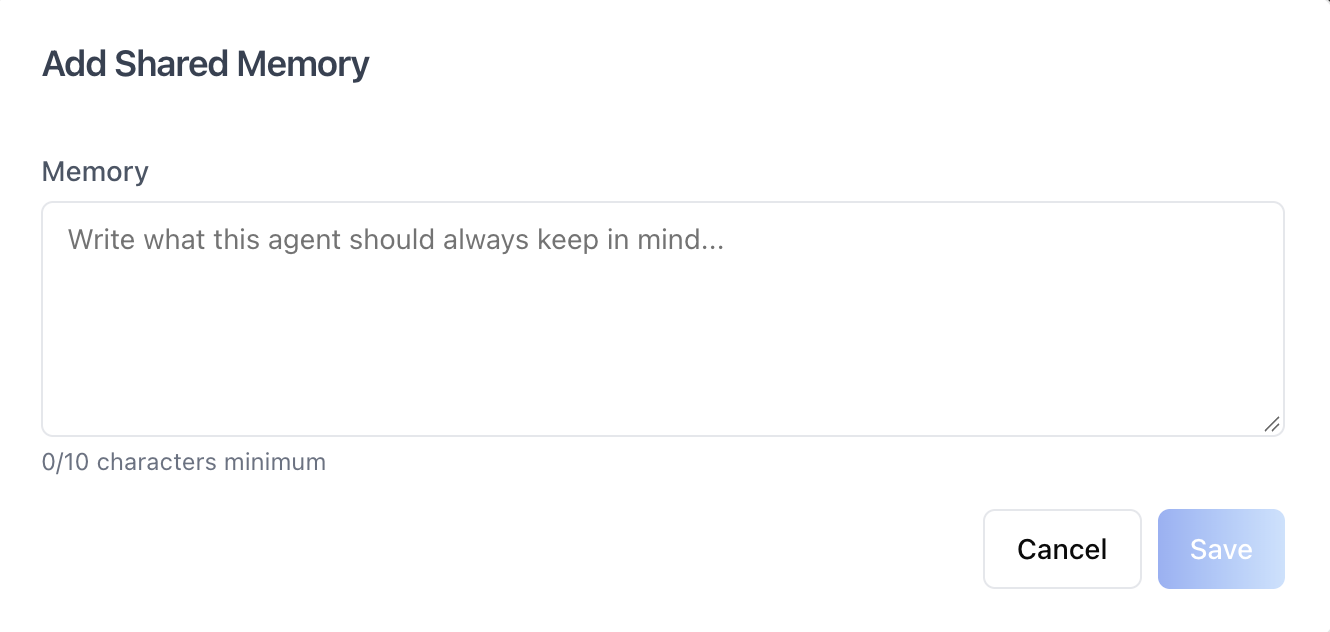
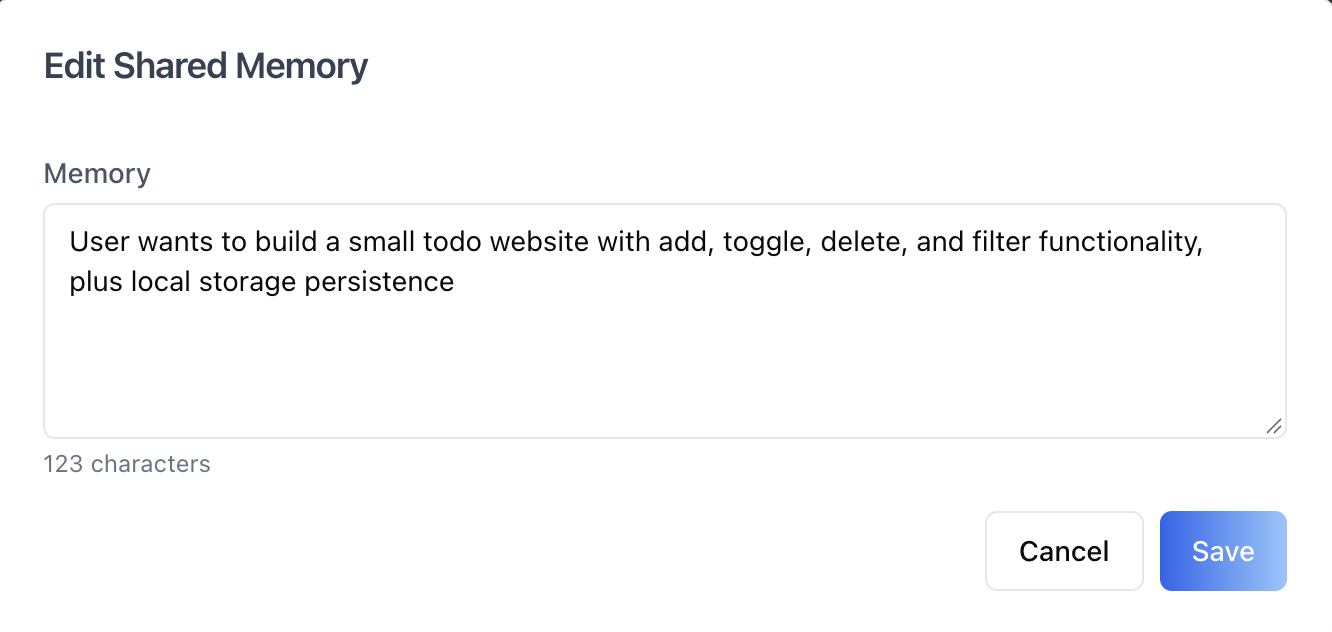
- Add / Edit Shared Memory dialog: one Memory textarea ("Write what this agent should always keep in mind..."), a counter that reads "0/10 characters minimum" until ten characters are typed and "123 characters" after; Save stays disabled below ten.
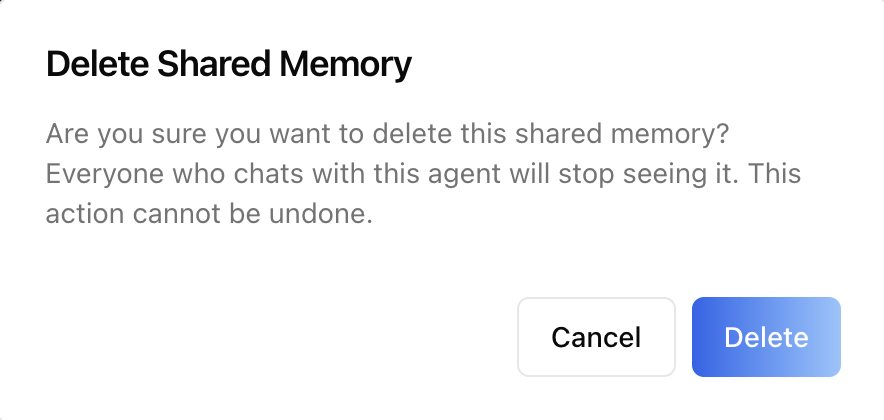
- Delete Shared Memory confirm: "Are you sure you want to delete this shared memory? Everyone who chats with this agent will stop seeing it. This action cannot be undone."
- Pagination appears past 20 entries; deleting the last entry on a page steps back a page first.
- Empty: "No Shared Memories Yet — Add anything this agent should always keep in mind — how to behave, key facts, or house rules."
- No list permission (403): "No Access to Shared Memory" in place of the list.
Errors the section handles
| Backend | Shown |
|---|---|
409 on save | "This shared memory already exists." under the field — entries dedupe on a content hash |
400 on save | "A shared memory must be at least 10 characters.", or the backend's own message for any other rule |
403 on any write | A toast, and the add button and kebabs disappear for the rest of the session |
| anything else | "Couldn't save shared memory" / "Couldn't delete shared memory" toasts |
Who may write
The permission check endpoint has no shared-memory actions, so the
agent's own write action stands in: with enableRBAC and a permission
tree that carries the agent (/mentors/{id}/), Limited Editor can
write and Limited Viewer cannot. When the tree has no entry for the
agent everything stays writable and the server's 403 is the source of
truth. The switch follows the same rule. Writes are withheld (not
briefly granted) while the agent settings are still loading.
Related Exports
From @iblai/iblai-js/web-containers/next:
AgentMemoryTab,AgentMemoryTabProps— this tab.AGENT_MEMORY_TAB_LABELS,MemoryTabLabels— the default label bundle and its type (now withsubTabsandsharedMemory).MEMORY_SUB_TABS—{ personal: 'personal', shared: 'shared' }, the sub-tab values.
From @iblai/iblai-js/data-layer:
- Shared Memory:
useGetSharedMemoriesQuery,useLazyGetSharedMemoriesQuery,useCreateSharedMemoryMutation,useUpdateSharedMemoryMutation,useDeleteSharedMemoryMutation, withSharedMemoryEntry(id,mentor_id,mentor_name,content,created_by,created_by_email,created_by_full_name,created_at,updated_at),SharedMemoryListResponseand theGetSharedMemoriesArgs/CreateSharedMemoryArgs/UpdateSharedMemoryArgs/DeleteSharedMemoryArgsshapes ({ org, mentorId, … }; the list takesparams.page/page_size≤ 100 /start_date/end_date). - Personal Memories:
useGetMentorMemoriesListQuery,useGetAllMentorMemoriesQuery,useCreateMentorMemoryMutation,useUpdateMentorMemoryMutation,useDeleteMentorMemoryMutation; categoriesuseGetMemoryCategoriesAdminQuery,useCreateMemoryCategoryMutation,useUpdateMemoryCategoryMutation,useDeleteMemoryCategoryMutation. - The switch:
useGetMentorSettingsQuery,useEditMentorMutation(enable_memory_component); the organization gate:useGetMemsearchStatusQuery.
Component map (internal to the tab, under
packages/web-containers/src/components/modals/edit-mentor-modal/tabs/memory-tab/):
| Component | File | Role |
|---|---|---|
AgentMemoryTab | index.tsx | Header, the CapabilityGate switch, the two sub-tabs |
ManageMemories | manage-memories.tsx | Personal Memories (also hosted by the org Memory admin's Agent popup) |
SharedMemorySection | shared-memory-section.tsx | Shared Memory list, pagination, state handling |
SharedMemoryModal | shared-memory-modal.tsx | Add / Edit dialog, 10-character minimum |
SharedMemoryDeleteModal | shared-memory-delete-modal.tsx | Delete confirmation |
classifySharedMemoryError | shared-memory-errors.ts | Maps 409 / 400 / 403 to the messages above |
useMemoryCapability | use-memory-capability.ts | The switch's optimistic save and the write-permission proxy |
Step 5: Verify
Run /iblai-vibe-ops-test before telling the user the work is ready, and give
every page, control and state this skill added its own checkpoint — one Playwright
test titled <ID> · … in e2e/journeys/, listed in e2e/coverage.json;
pnpm e2e:coverage must pass:
pnpm build-- must pass with zero errorspnpm test-- vitest must pass- Touch test
/agents/<id>/memoryin the browser as/iblai-vibe-ops-testsays: open it, use every control this skill added, read the console, check the phone width.
Stable selectors: memory-capability-toggle, memory-sub-tabs,
memory-sub-tab-personal, memory-sub-tab-shared,
shared-memory-section, shared-memory-add-button,
shared-memory-entry, shared-memory-modal, shared-memory-content,
shared-memory-save, shared-memory-delete-modal,
shared-memory-delete-confirm, shared-memory-empty,
shared-memory-denied, shared-memory-pagination.
Important Notes
- Redux store: Must include
mentorReducerandmentorMiddleware initializeDataLayer(): 5 args (v1.2+)@reduxjs/toolkit: Deduplicated via webpack aliases innext.config.ts- Peer deps:
sonnerand@iblai/iblai-web-mentormust be installed (pnpm add sonner @iblai/iblai-web-mentor) - Provider optional: the tab uses
useAgentSettingsOptional, so it works insideAgentSettingsProvideror with explicit identity props. - Three gates: organization
enable_memsearch, this tab's switch (enable_memory_component), and the person's ownuse_memory_in_responses. Shared memories reach a chat only when all three are on — the info box on the sub-tab says exactly that. - Shared Memory is not personal data. Everyone who chats with the agent gets it; put behaviour, facts and house rules there, never something about one person — that belongs in Personal Memories.
- Shared Memory lives here only. The organization's Memory admin
(
/iblai-vibe-memory) manages personal memories per agent; it does not show Shared Memory. - Entries dedupe: an identical shared memory is refused with
409, surfaced under the field; a save needs at least 10 characters. - Agent switch remounts the section, so the page and the write-denied flag start over for the next agent.
- Brand guidelines: BRAND.md
Memory REST API
Full REST reference: /iblai-api-agent-memory
(headless twin, installed with the rest of this repo's skills).
The tables below are the frontend-relevant summary.
For custom UI beyond <AgentMemoryTab>. All endpoints are prefixed with
${dmUrl}/api/ai-mentor/orgs/{org}/ where dmUrl is NEXT_PUBLIC_API_BASE_URL
and {org} is the org key (platform_key).
The system has three control levels: Platform (admin enables for organization), Agent (admin/owner enables per agent), User (user opts in/out of capture and use).
User memory settings (per user opt-in)
| Method | Path | Purpose |
|---|---|---|
| GET | users/{user_id}/memsearch-settings/ | Read auto_capture_enabled, use_memory_in_responses |
| PUT | users/{user_id}/memsearch-settings/ | Update one or both flags |
Defaults are false if no settings row exists.
Platform config (organization admin)
| Method | Path | Purpose |
|---|---|---|
| GET | users/{user_id}/memsearch-config/ | Read enable_memsearch |
| POST | users/{user_id}/memsearch-config/ | Set enable_memsearch |
| GET | users/{user_id}/memsearch-status/ | Read-only enabled status for the organization |
Agent toggle
| Method | Path | Purpose |
|---|---|---|
| PUT | users/{user_id}/mentors/{mentor}/settings/ | Body includes enable_memory_component: bool |
Every memory row identifies its owner with username, email and
user_full_name, so a list renders the person without a second request; a
shared-memory row names its curator with created_by, created_by_email and
created_by_full_name instead.
Shared Memory (agent knowledge — no user segment)
| Method | Path | Purpose |
|---|---|---|
| GET | mentors/{mentor_id}/agent-memories/ | Paged list. Params: page, page_size (≤100, default 20), start_date, end_date |
| POST | mentors/{mentor_id}/agent-memories/ | Create. Body { content } (≥10 chars). 201; 409 if an identical entry exists |
| PATCH | mentors/{mentor_id}/agent-memories/{memory_id}/ | Update content |
| DELETE | mentors/{mentor_id}/agent-memories/{memory_id}/ | Delete → 204 |
Global memories (apply across all agents)
| Method | Path | Purpose |
|---|---|---|
| GET | users/{user_id}/global-memories/ | List. Params: page, page_size (≤25), user_id, start_date, end_date, search |
| POST | users/{user_id}/global-memories/ | Create. Body { content } (≥10 chars). 409 if duplicate |
| DELETE | users/{user_id}/global-memories/{memory_id}/ | Delete |
Agent-specific memories (grouped by category)
| Method | Path | Purpose |
|---|---|---|
| GET | users/{user_id}/mentors/{mentor_id}/mentor-memories/ | List grouped by category. Params: user_id, start_date, end_date, my_memory |
| POST | users/{user_id}/mentors/{mentor_id}/mentor-memories/ | Create. Body { category_slug, content } (≥10 chars) |
| PATCH | users/{user_id}/mentors/{mentor_id}/mentor-memories/{memory_id}/ | Partial update of content and/or category_slug |
| DELETE | users/{user_id}/mentors/{mentor_id}/mentor-memories/{memory_id}/ | Delete |
Memory categories (admin/owner)
| Method | Path | Purpose |
|---|---|---|
| GET | mentors/{mentor_id}/memory-categories/ | List active categories |
| POST | mentors/{mentor_id}/memory-categories/ | Create. 409 if slug exists |
| PATCH | mentors/{mentor_id}/memory-categories/{category_id}/ | Update name/description/extraction prompt |
| DELETE | mentors/{mentor_id}/memory-categories/{category_id}/ | Soft-delete (sets is_active=false) |
Default categories auto-created per agent: knowledge_gaps, learning_goals,
preferences, progress_milestones, personal_context.
Common errors
400 validation (content <10 chars), 403 viewing another user's memories
or writing shared memory without the agent's write action, 404 not found,
409 duplicate.
Visibility rule
Hide memory UI unless platform memsearch-status is enabled AND the agent's
enable_memory_component is true. Always show the user-level toggles so users
can opt in/out.