/iblai-vibe-agent-privacy
Mirrored from
iblai/vibe·skills/agents/iblai-vibe-agent-privacy/SKILL.md. This page is generated — edit it in the repository, not here.
Add the agent Privacy tab -- "Control what personal information the agent sees and how Incognito works for its conversations." Scope: per agent. Every control saves at once to the agent's settings, so it applies to everyone who chats with the agent. Two sub-tabs behind one pill switcher:
- PII Filtering — an inline PII filtering toggle; when on, what to do when PII is detected (Allow, Redact, Mask, Block), the Block Message, the Entity Types chips (Person, Email, Phone, SSN, Credit Card, Location, Date / Time, Passport, Driver's License, IP Address, IBAN, Medical License, Bank Number) and Also filter AI responses.
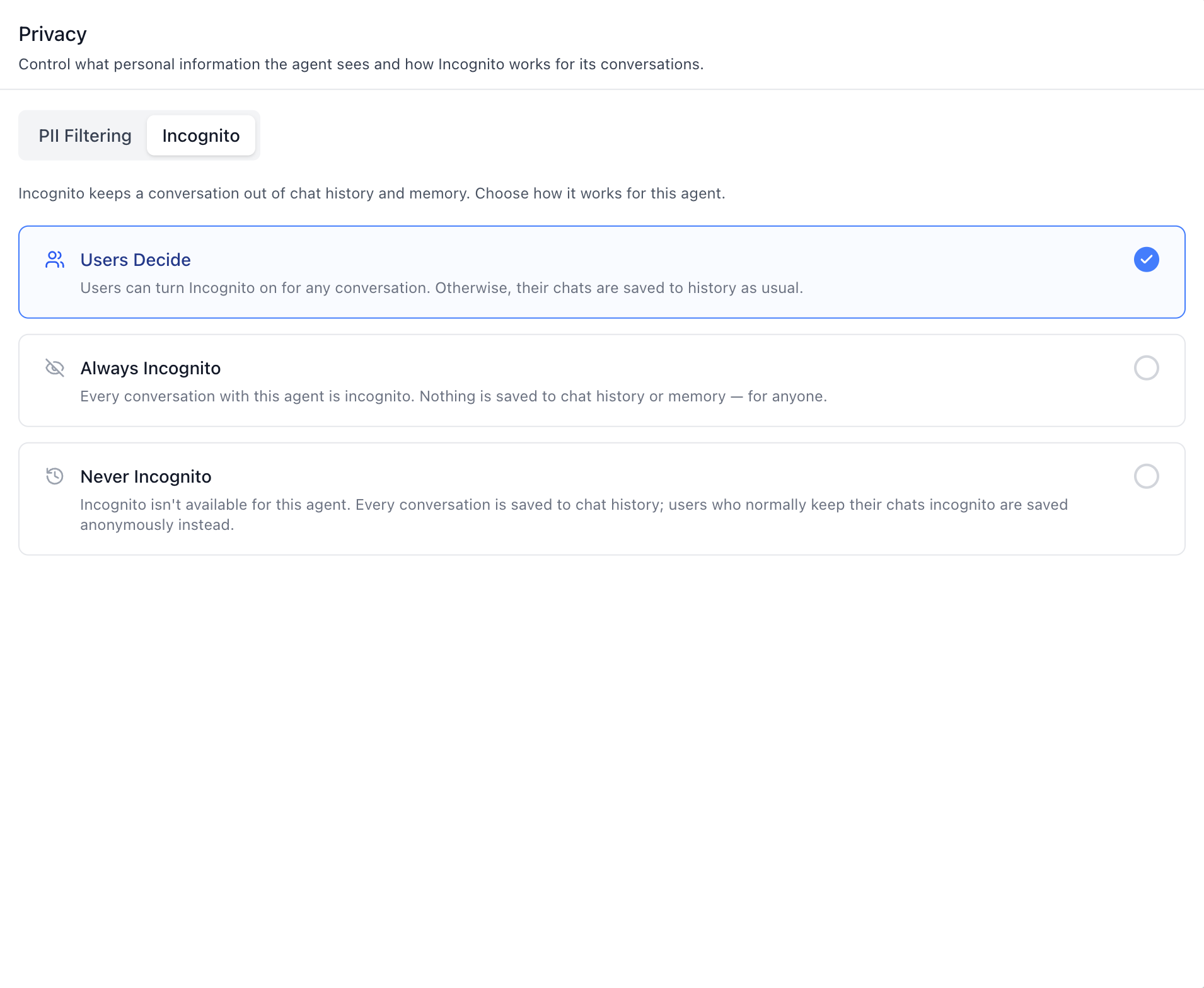
- Incognito — one choice over how Incognito works for this agent: Users Decide, Always Incognito, or Never Incognito. This replaces the old Private Mode switch that lived on the Settings tab.
This is one tab in the agent-settings family indexed by /iblai-vibe-agent;
it shares the AgentSettingsProvider wrapper with every other tab (optional
for this tab — identity can be passed as props).
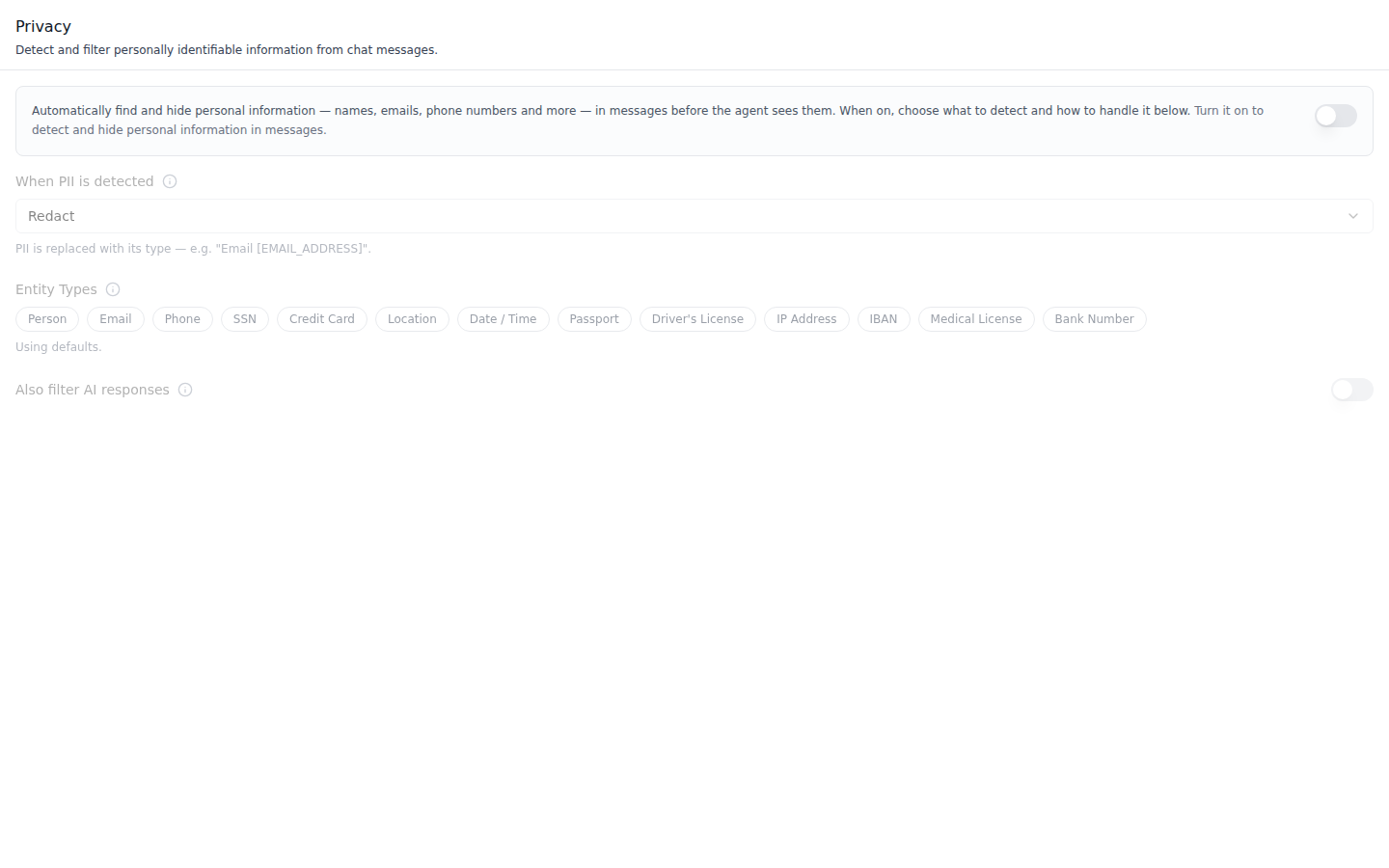
PII filtering off -- the switch at the top turns the Privacy Router on. While it is off, the controls below stay visible but grayed out, so admins can see what they would get.
On, with Redact -- When PII is detected picks the action (the line under it explains it), Entity Types picks what to detect (none selected means the defaults), and Also filter AI responses applies the same filter to the agent's replies.
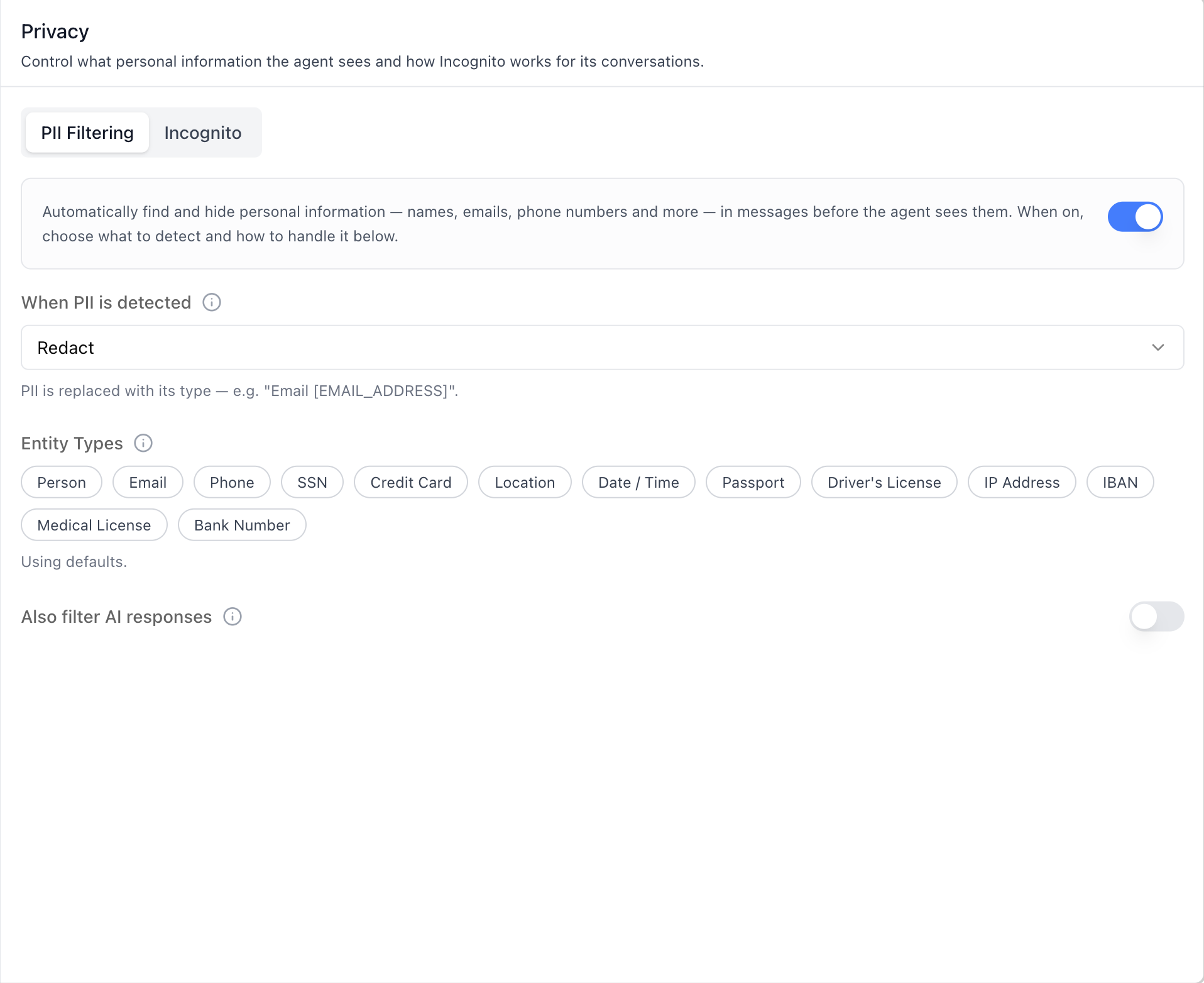
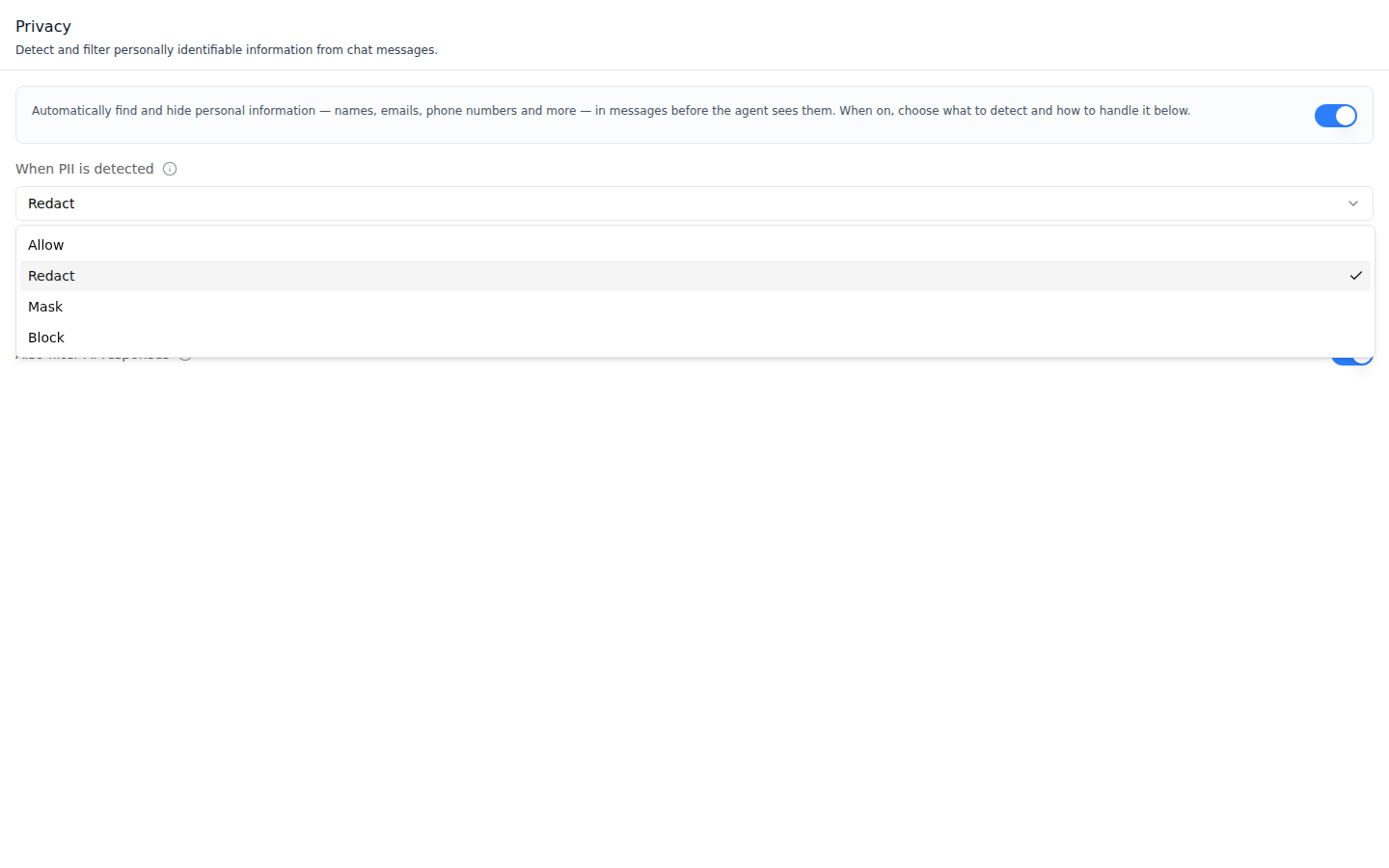
Actions -- Allow (detect and log, leave the message unchanged),
Redact (replace with the type, e.g. [EMAIL_ADDRESS]), Mask (replace
with asterisks), Block (reject the message).
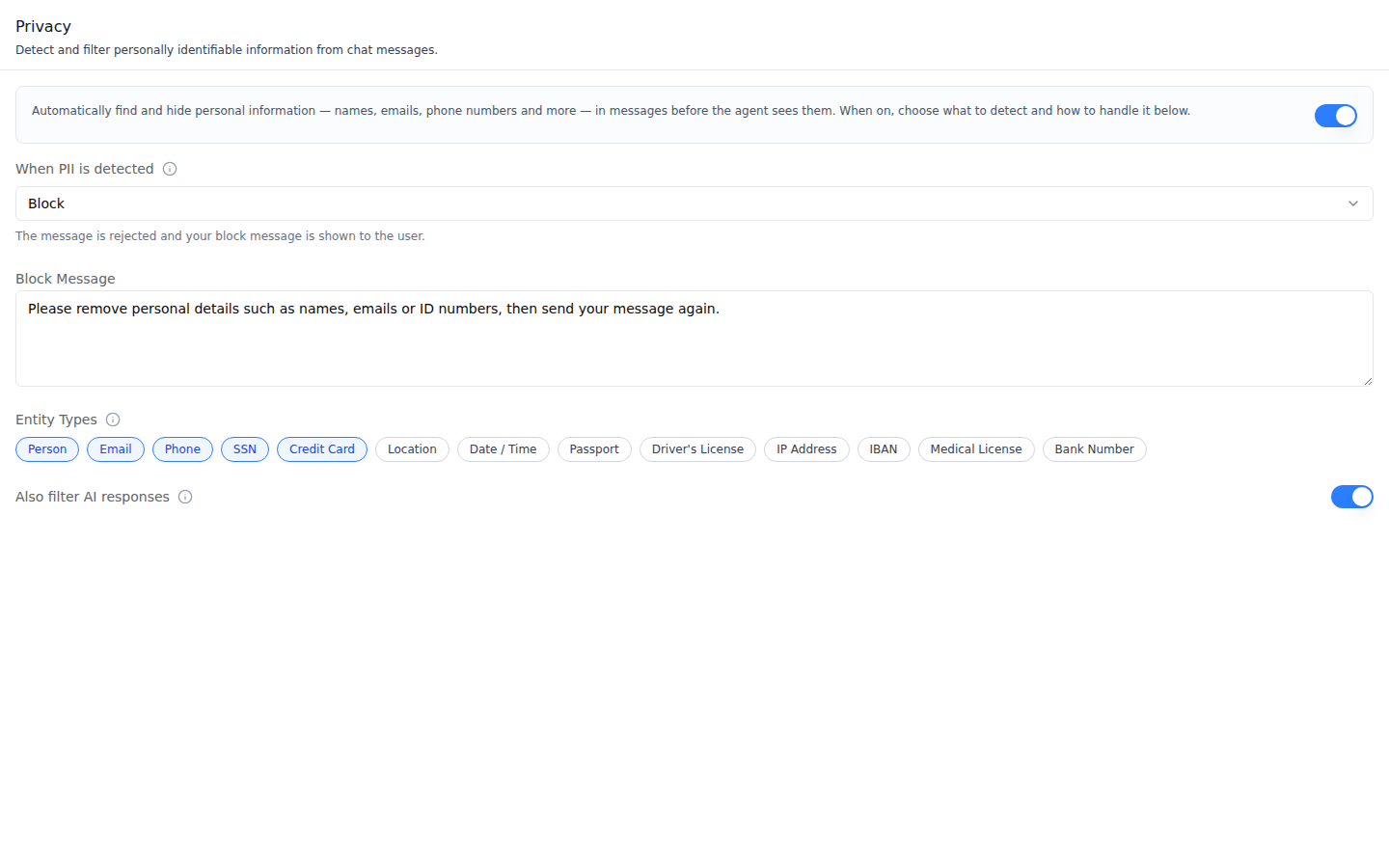
Block -- adds Block Message, the text the user sees instead of an answer. It saves when the field loses focus.
Incognito -- the three cards, offered only when the organization allows it (Prerequisites).
Common setup (brand, conventions, env files, verification): see docs/skill-setup.md.
Related Incognito surfaces
Incognito is one feature with four tiers; this tab is the agent
tier. /iblai-vibe-incognito explains how they resolve and mounts the
in-chat toggle.
/iblai-vibe-incognito— the chat-header Incognito toggle and its "Enable Incognito for this chat?" dialog, plus the tier order./iblai-vibe-profile— the user's own Privacy tab: their default (Normal / Anonymized / Incognito)./iblai-vibe-account— organization settings → Advanced → "Allow users to control chat privacy", the gate that makes the Incognito sub-tab (and the toggle) exist at all.
Prerequisites
- Auth set up (
/iblai-vibe-auth, or vibe-starter). AgentSettingsProviderwraps the route (/iblai-vibe-agent§1), or passtenantKey/mentorId/usernameas props.@iblai/iblai-js@^2.62.1(resolves@iblai/web-containers1.62.1). Check withpnpm why @iblai/web-containers.- A real agent UUID. Ask the user; never invent one.
- The Incognito sub-tab appears only when the organization allows
user chat-privacy control (
allow_user_chat_privacy_control). With the gate off there is no Incognito to govern, and the tab shows PII Filtering alone.
Step 1: Check Environment
Look for iblai.env in the project root with PLATFORM, DOMAIN, and
TOKEN. If it is missing, tell the user:
"You need an iblai.env with your platform configuration. Download the
template and fill in your values:
curl -o iblai.env https://raw.githubusercontent.com/iblai/vibe/refs/heads/main/iblai.env"
Step 2: Mount AgentPrivacyTab
// app/(app)/agents/[mentorId]/privacy/page.tsx
"use client";

import { AgentPrivacyTab } from "@iblai/iblai-js/web-containers/next";

export default function AgentPrivacyPage() {
  return (
    <div className="flex h-full flex-col bg-white">
      <AgentPrivacyTab />
    </div>
  );
}
The tab reads tenantKey, mentorId, username, enableRBAC and
executeGatedAction from AgentSettingsProvider, loads the agent settings
and the organization's chat-privacy gate, and decides which sub-tabs to offer
(see Which sub-tabs appear below). Each can be passed as a prop instead,
for example to mount the tab outside the provider:
import { AgentPrivacyTab } from "@iblai/iblai-js/web-containers/next";

export function PrivacyPanel(props: { org: string; agentId: string; username: string }) {
  return (
    <AgentPrivacyTab tenantKey={props.org} mentorId={props.agentId} username={props.username} />
  );
}
With enableRBAC on, each control follows the agent's field permissions
(enable_privacy_router, privacy_action, privacy_response,
privacy_entities, enable_privacy_output_filter, disable_chathistory,
disable_privacy_mode) and is disabled when the user may not edit it.
executeGatedAction wraps every save, so the host can put a paywall or
confirmation in front of it.
Step 3: Customize Labels (Optional)
The tab renders with the default agent-facing copy
(AGENT_PRIVACY_TAB_LABELS, localized through the SDK's i18n). Pass a
partial labels object to change any string:
import { AgentPrivacyTab } from "@iblai/iblai-js/web-containers/next";

<AgentPrivacyTab
  labels={{
    header: { title: "Data privacy", description: "Filter PII; decide how Incognito works." },
    subTabs: { piiFiltering: "Personal data", incognito: "Incognito" },
    fields: { action: { options: { allow: "Log only" } } },
    incognito: {
      options: { always: { title: "Always private", description: "Nothing is ever saved." } },
    },
  }}
/>;
Label groups (PrivacyTabLabels): header (title, description),
capability (the switch: title, description, offHint), fields --
action (label, tooltip, options and descriptions per action),
blockMessage (label, placeholder), entities (label, tooltip,
emptyHint, labels per entity type), outputFilter (label, tooltip),
enableRouter -- subTabs (piiFiltering, incognito), incognito
(description, groupAriaLabel, options per card), noAccess, and toasts
(updateSuccess, updateError).
Step 4: Use MCP Tools for Customization
get_component_info("AgentPrivacyTab")
get_component_info("AgentSettingsProvider")
get_component_info("ChatPrivacyToggle")
<AgentPrivacyTab> Props
Import from @iblai/iblai-js/web-containers/next.
| Prop | Type | Required | Description |
|---|---|---|---|
labels | DeepPartial<PrivacyTabLabels> | No | Override user-visible strings |
tenantKey | string | No | Organization key; defaults to AgentSettingsProvider |
mentorId | string | No | Agent UUID; defaults to AgentSettingsProvider |
username | string | No | Signed-in username; defaults to AgentSettingsProvider |
enableRBAC | boolean | No | Follow the agent's field permissions; defaults to the provider, else false |
executeGatedAction | (fn: () => unknown) => unknown | No | Wrap every save (paywall, confirmation); defaults to the provider |
What each sub-tab renders
PII Filtering
PII filtering capability card — the on/off switch sits inline at the top of the sub-tab with its explanation. When it is off the controls below stay visible but inert, so an admin can preview what they will get before turning it on.
When PII is detected — a select with an inline description of the chosen action:
Action Wire value What happens Allow allowDetected but left untouched — the message passes through unchanged. For monitoring or auditing without altering messages Redact (default) redactReplaced with its type — e.g. Email [EMAIL_ADDRESS]Mask maskHidden behind asterisks — e.g. Email ***********Block blockThe message is rejected and your block message is shown Block Message — a textarea shown only for Block; saves on blur.
Entity Types — the 13 chips, multi-select. With none selected the hint reads "Using defaults."
Also filter AI responses — scrubs PII from the agent's output as well (may add slight latency to streamed responses).
Incognito
"Incognito keeps a conversation out of chat history and memory. Choose how it works for this agent." Three radio cards:
| Card | Flags saved | Effect in the chat header |
|---|---|---|
| Users Decide | disable_chathistory: false, disable_privacy_mode: false | Users can turn Incognito on for any conversation; otherwise chats are saved as usual |
| Always Incognito | disable_chathistory: true | Every conversation is incognito, for anyone. The Incognito pill shows locked on |
| Never Incognito | disable_privacy_mode: true | Incognito isn't available for this agent; the toggle disappears. Users whose profile default is Incognito are saved anonymously instead |
One control writes both flags in the same PUT, so the contradictory
"always and never" pair cannot be configured from here. A record that
still carries both (older data) behaves as Always Incognito: the
backend checks disable_chathistory first, answers mode: disabled,
source: mentor, and writes no history — even though the tab displays
it as Never Incognito. Choosing any card rewrites both flags and clears
the mismatch.
Which sub-tabs appear
| Condition | Result |
|---|---|
Organization gate allow_user_chat_privacy_control off | Incognito sub-tab not offered |
enableRBAC and no PII field is readable (permissions.field) | PII Filtering not offered |
enableRBAC and either Incognito flag is unreadable | Incognito not offered |
| Nothing readable | The tab shows a single notice: "You don't have permission to view this agent's privacy settings." |
Members typically see Incognito read-only and no PII Filtering. Writes stay per control: a field the user may read but not write renders disabled.
Settings fields
Read with GET and written with PUT on
${dmUrl}/api/ai-mentor/orgs/{org}/users/{username}/mentors/{mentor_unique_id}/settings/
(a partial update — send only what changes):
| Field | Type | Sub-tab |
|---|---|---|
enable_privacy_router | boolean | PII Filtering — the capability switch |
privacy_action | "allow" | "redact" | "mask" | "block" | PII Filtering |
privacy_response | string | PII Filtering — the block message |
privacy_entities | string[] (PERSON, EMAIL_ADDRESS, …) — [] means defaults | PII Filtering |
enable_privacy_output_filter | boolean | PII Filtering |
disable_chathistory | boolean | Incognito — Always |
disable_privacy_mode | boolean | null (null = off on older records) | Incognito — Never |
Related Exports
From @iblai/iblai-js/web-containers/next:
AGENT_PRIVACY_TAB_LABELS-- the default label bundle.AgentPrivacyTabProps,PrivacyTabLabels-- types.
From @iblai/iblai-js/web-containers: ChatPrivacyToggle -- the chat-header
toggle that reacts to the Incognito policy (/iblai-vibe-incognito).
From @iblai/iblai-js/data-layer:
PRIVACY_ACTIONS(allow,redact,mask,block),PRIVACY_ENTITY_TYPES(PERSON,EMAIL_ADDRESS,PHONE_NUMBER,US_SSN,CREDIT_CARD,LOCATION,DATE_TIME,US_PASSPORT,US_DRIVER_LICENSE,IP_ADDRESS,IBAN_CODE,MEDICAL_LICENSE,US_BANK_NUMBER),DEFAULT_PRIVACY_ACTION,DEFAULT_PRIVACY_RESPONSE, and thePrivacyAction/PrivacyEntityTypetypes.isPrivacyBlockedError,PRIVACY_BLOCKED_ERROR_KIND-- recognise theprivacy_blockederror a Block action sends over the chat stream, to style it apart from a moderation block.MentorChatPrivacyPublicSettings--disable_privacy_modeas members read it from the agent's public settings.
Platform data
| Hook | Purpose |
|---|---|
useGetMentorSettingsQuery | Current privacy fields and field permissions |
useEditMentorJsonMutation | Save a change (JSON, so privacy_entities stays an array) |
useGetTenantChatPrivacyConfigQuery | The organization gate the Incognito sub-tab depends on |
REST twin: /iblai-api-agent-privacy
(also the privacy-flags audit log of every detection, which this tab does
not show).
Step 5: Verify
Run /iblai-vibe-ops-test before telling the user the work is ready, and give
every page, control and state this skill added its own checkpoint — one Playwright
test titled <ID> · … in e2e/journeys/, listed in e2e/coverage.json;
pnpm e2e:coverage must pass:
pnpm build-- must pass with zero errors.pnpm test-- vitest must pass.- Touch test
/agents/<uuid>/privacyin the browser as/iblai-vibe-ops-testsays, signed in as an org admin: the controls render grayed out; turn PII filtering on, pick Block -- the Block Message field appears; pick each Incognito card; read the console; check the phone width.
Stable selectors: privacy-sub-tab-pii, privacy-sub-tab-incognito,
privacy-capability-toggle, privacy-incognito-{users|always|never}
(with aria-pressed), privacy-no-access.
Important Notes
- Saves on every click: there is no Save button. Try settings on a test agent.
- Allow still detects: detections are logged to the
privacy-flagsaudit log; only the message is left alone. - JSON settings endpoint: all fields are persisted via the JSON
/settings/mutation (useEditMentorJsonMutation), not the multipart variant, soprivacy_entitiesround-trips cleanly. The tab refetches agent settings after each save because that mutation does not invalidate the settings cache tag. - Incognito saves refresh the chat header: choosing a card also
invalidates
ChatPrivacyEffectiveand the agent'smentorPublicSettingscaches, so an open chat's Incognito pill locks, unlocks or disappears without a reload. Custom UI writing the two flags must do the same. - Private Mode moved: the switch that used to sit on the Settings tab's capabilities is gone; the Incognito sub-tab here is its replacement, and the user-facing name is now Incognito everywhere.
- Shared provider: mount
AgentSettingsProvideronce at the layout level (/iblai-vibe-agent§1); do not wrap each tab. - Peer deps:
sonnerand@iblai/iblai-web-mentor(pnpm add sonner @iblai/iblai-web-mentor). - Brand guidelines: BRAND.md