Agent Settings: Memory
Overview
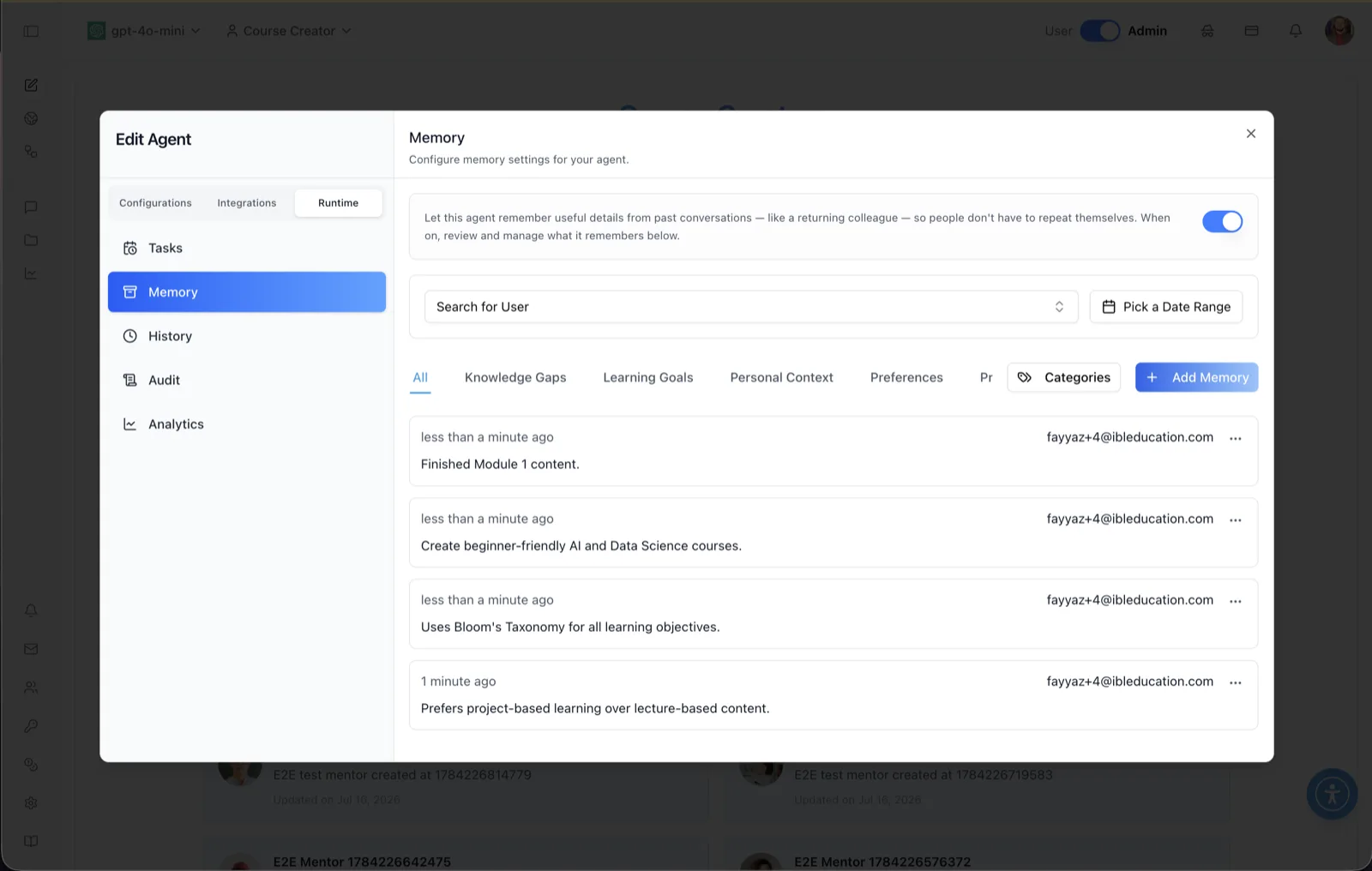
The Memory panel reviews and manages what an agent remembers about individual users across conversations. The panel header reads: "Configure memory settings for your agent," and the helper text explains: "Let this agent remember useful details from past conversations — like a returning colleague — so people don't have to repeat themselves. When on, review and manage what it remembers below," with a master toggle to turn memory on or off for the agent.
Each saved memory is a card showing when it was captured (for example, "less than a minute ago"), which user it belongs to (their email), and the remembered fact (for example, "Prefers project-based learning over lecture-based content."). Memories are organized into categories and can be filtered, added, edited, and deleted by administrators.
To reach this screen, open the Edit Agent modal, switch to the Runtime tab group (its sidebar lists Tasks, Memory, History, Audit, and Analytics), and select Memory.
Target Audience
Administrator | Agent Builder
Panel Reference
Memory toggle
The switch in the helper banner enables or disables memory for this agent. When on, the agent stores and references useful details from conversations; when off, it does not remember users between sessions. (Conversations in private mode never store memory regardless of this setting.)
Search for User
A searchable dropdown listing the users who have saved memories (by email), plus an All Users option. Selecting a user filters the memory list to just that person.
Pick a Date Range
Filters the memory list to entries captured within a chosen date range.
Category tabs
Filter tabs across the top of the list: All plus the organization's memory categories — the screenshot shows Knowledge Gaps, Learning Goals, Personal Context, and Preferences. Up to six categories are shown inline; additional ones collapse into a More menu. Categories are admin-defined, so your set may differ.
Categories
Opens the Manage Categories dialog, where you can add a new category by name, rename existing ones, and delete them (with confirmation). Categories structure how memories are classified and filtered.
Add Memory
Opens the Add Memory dialog: pick a Category, type the Memory content (10-character minimum), and click Save. This lets an administrator seed or correct what the agent knows about users without waiting for it to be learned in conversation.
Memory cards
Each card shows the memory's relative timestamp, the owning user's email, and the memory text. The "..." actions menu on a card offers Edit (change the content or category) and Delete (with confirmation). A Delete All action is available to bulk-delete the memories in the current category filter.
How to Use
Step 1: Open the Memory panel
Open the Edit Agent modal, click the Runtime tab group, then select Memory.
Step 2: Turn memory on
Enable the toggle in the banner so the agent remembers useful details from past conversations. Pair this with the Remember past conversations capability so memory is active in chat.
Step 3: Review what the agent remembers
Filter by user with Search for User, narrow by date with Pick a Date Range, and switch category tabs (Knowledge Gaps, Learning Goals, Personal Context, Preferences, and so on) to audit stored memories.
Step 4: Curate memories
Use Add Memory to insert facts the agent should know, the card's Edit action to fix inaccurate ones, and Delete (or Delete All) to remove anything that should not be retained.
Step 5: Maintain categories
Click Categories to add, rename, or remove memory categories as your classification needs evolve.